The WHO-commissioned systematic reviews on health effects of radiofrequency radiation provide no assurance of safety

https://ehjournal.biomedcentral.com/articles/10.1186/s12940-025-01220-4

Abstract

The World Health Organization (WHO) commissioned 12 systematic reviews (SR) and meta-analyses (MA) on health effects of exposure to radiofrequency electromagnetic fields (RF-EMF). The health outcomes selected for those reviews (cancer, electromagnetic hypersensitivity, cognitive impairment, birth outcomes, male fertility, oxidative stress, and heat-related effects) were based on a WHO-conducted international survey. The SR of the studies of cancer in laboratory animal studies was the only one that did not include a MA, because those authors considered it inappropriate due to methodological differences among the available studies, including differences in exposure characteristics (carrier frequency, modulation, polarization), experimental parameters (hours/day of exposure, duration of exposure, exposure systems), and different biological models. MAs in all the other SRs suffered from relatively few primary studies available for each MA (sometimes due to excessive subgrouping), exclusion of relevant studies, weaknesses in many of the included primary studies, lack of a framework for analyzing complex processes such as those involved in cognitive functions, and/or high between-study heterogeneity. Due to serious methodological flaws and weaknesses in the conduct of the reviews and MAs on health effects of RF-EMF exposure, the WHO-commissioned SRs cannot be used as proof of safety of cell phones and other wireless communication devices. However, the animal cancer SR, which was rated as “high certainty of evidence” for heart schwannomas and “moderate certainty of evidence” for brain gliomas, provided quantitative information that could be used to set exposure limits based on reducing cancer risk. The multiple and significant dose-related adverse effects found in the SRs on male fertility and pregnancy and birth outcome should also serve as the basis for policy decisions to lower exposure limits and reduce human reproductive risks. The report of harmful effects (e.g., cancer, reproductive toxicity, etc.) at doses below the adverse health effect threshold claimed by ICNIRP demonstrates that current exposure limits to RF-EMF, which were established by applying arbitrary uncertainty factors to their putative adverse threshold dose, lack scientific credibility….

READ FULL ARTICLE HERE

See Also

Microwave News article : ICBE-EMF: Health Reviews Suffer from Faulty Analysis & ICNIRP Bias

Posted in Uncategorized | Comments Off on The WHO-commissioned systematic reviews on health effects of radiofrequency radiation provide no assurance of safety

Health Risks of Wireless Radiation for Children, Elderly & Vulnerable Groups Dr. Erica Mallery-Blythe

Source Website : ICBE International Commission on the Biological Effects of Electromagnetic Fields

Wireless technologies are everywhere — from mobile phones and Wi-Fi routers to Bluetooth gadgets. While these devices offer convenience, they also emit wireless radiation, a type of non-ionizing electromagnetic radiation. 

Dr. Erica Mallery-Blythe, a UK medical doctor and founder of the Physicians’ Health Initiative for Radiation and Environment (PHIRE), raises urgent concerns about the health impacts of non-ionizing radiation, especially for vulnerable populations such as children, the elderly, those with electromagnetic sensitivity, and the chronically ill.

In this presentation, Dr. Mallery-Blythe highlights how current safety standards for wireless radiation (ICNIRP and FCC limits) fail to account for these risks, leaving millions exposed without adequate protection…..

Posted in Uncategorized | Comments Off on Health Risks of Wireless Radiation for Children, Elderly & Vulnerable Groups Dr. Erica Mallery-Blythe

New Global Framework for the Protection of Human Health and the Environment from Wireless RF Radiation – Ronald Melnick PhD 

Source: International Commission on the Biological Effects of Electromagnetic Fields (ICEB-EMF.org)

In this video, Ron Melnick, PhD, chairperson of the International Commission on the Biological Effects of Electromagnetic Fields (ICBE-EMF) explains why existing safety standards for wireless radiofrequency (RF) radiation are outdated. 

Melnick led the design of landmark studies at the National Toxicology Program that found links between cell phone RF radiation exposure and cancer in animals, yet regulatory agencies never acted on the findings. He has served on numerous scientific review boards and was a member of the scientific working group of the WHO’s International Agency for Research on Cancer evaluation of cell phone and wireless RF.

Melnick emphasizes that current radiofrequency (RF) exposure limits, set in the 1990s and reaffirmed in 2020, are outdated and based only on short-term animal tests that ignored long-term and non-thermal effects….

Posted in Uncategorized | Comments Off on New Global Framework for the Protection of Human Health and the Environment from Wireless RF Radiation – Ronald Melnick PhD 

Cell Phone Radiation, Cell Tower Antennas and Cancer: Scientific Research on Human Epidemiological and Case Studies – Lennart Hardell, MD, Ph.D

Source Article: International Commission on the Biological Effects of Electromagnetic Fields

Concerns about the health effects of wireless radiofrequency (RF) radiation have been growing as cell phone (mobile phone) use, 5G deployment, and cell tower installations expand across cities worldwide. 

In this presentation, Professor Lennart Hardell, a leading researcher with decades of work on environmental and cancer risks, highlighted the scientific evidence indicating that everyday exposures to wireless RF are not safe, even at legally allowed levels. 

According to Dr. Hardell, “Human epidemiological and case studies on RFR exposure from cell phones and antennas show evidence of harmful effects for people.” 

Vimeo Link, PDF of powerpoint slides 

Real-World RF Radiation Exposure from Cell Antennas

Hardell’s presentation documented how antennas are increasingly positioned in places that involuntarily expose the public to RF. His presentation references his publications measuring RF exposure in the real world which found ordinary citizens, including children, commuters, and workers, are regularly within close range of high-powered antennas without awareness or consent.

Clinical Evidence of Microwave Illness

Beyond environmental surveys of RF levels, Hardell also presented clinical data that point to biological effects of long-term RFR exposure. In collaboration with Mona Nilsson, he summarized seven Swedish case reports of individuals reporting acute onset of microwave syndrome symptoms such as sleep disturbance, fatigue, headache, memory impairment, and skin problems. The health symptoms subsided when individuals relocated to lower RF exposure environments. 

Perhaps the most urgent message from Hardell’s presentation is the disconnect between current international exposure guidelines and scientific research. While regulatory agencies use the ICNIRP limits which base safety limits on short-term heating effects, case studies and epidemiological research are documenting adverse outcomes, including neurological symptoms and tumor risks, at exposure levels well below those limits. Existing standards are not adequately protecting public health. The presentation by Dr. Hardell reinforces the importance of recognizing that RFR exposure is not only a technological issue but also a public health challenge.

Sign up for ICBE-EMFs Mailing list here to get science updates from the Commission.

About Dr. Lennart Hardell

Hardell has a long career as both a physician oncologist and as a cancer epidemiologist, now retired from the Department of Oncology, Örebro University hospital. He now leads the Environment and Cancer Research Foundation, promoting scientific research on the association between the environment and cancer and other chronic diseases.  In the late 1970’s and early 1980’s he was the first to document an increased risk for cancer in persons exposed to phenoxy herbicides and contaminating dioxins and his group has also conducted studies on the cancer risk of persistent organic pollutants, such as PCB and the risk for malignant lymphoma.

Dr. Hardell has published more than 380 peer-reviewed scientific articles and his research has contributed to the cancer classification of different agents such as TCDD, PCB, the herbicide glyphosate, and radio-frequency fields. Dr. Hardell was also an invited member of the scientific working groups of the WHO International Agency for Research on Cancer evaluation of RF. 

Some of the Scientific Publications on Wireless Radiation by Dr. Hardell  

Lennart Hardell, Mona Nilsson. High Radiofrequency Radiation in the Surroundings of 10 Schools in Örebro. Fortune Journal of Health Sciences 

Hardell, L., & Koppel, T. (2022). Electromagnetic hypersensitivity close to mobile phone base stations – a case study in Stockholm, Sweden. Reviews on Environmental Health.  

Khurana, V. G., Hardell, L., Everaert, J., Bortkiewicz, A., Carlberg, M., & Ahonen, M. (2010). Epidemiological evidence for a health risk from mobile phone base stations. International Journal of Occupational and Environmental Health 

Koppel, T., Ahonen, M., Carlberg, M., & Hardell, L. (2022). Very high radiofrequency radiation at Skeppsbron in Stockholm, Sweden from mobile phone base station antennas positioned close to pedestrians’ heads. Environmental Research 

Hardell, L., & Nilsson, M. (2023). Case Report: The Microwave Syndrome after Installation of 5G Emphasizes the Need for Protection from Radiofrequency Radiation. Annals of Case Reports

Hardell, Lennart and Nilsson, Mona. “Summary of seven Swedish case reports on the microwave syndrome associated with 5G radiofrequency radiation Reviews on Environmental Health, 2024. 

Hardell, L., Carlberg, M., Koppel, T., Nordström, M., Hedendah, L. Kl. (2020). Central nervous system lymphoma and radiofrequency radiation – A case report and incidence data in the Swedish Cancer Register on non-Hodgkin lymphoma. Medical Hypotheses 

Hardell, L. (2017). World Health Organization, radiofrequency radiation and health—A hard nut to crack (Review). International Journal of Oncology 

Hardell, L., & Carlberg, M. (2020). [Comment] Health risks from radiofrequency radiation, including 5G, should be assessed by experts with no conflicts of interest. Oncology Letters,  

Hardell, L., & Carlberg, M. (2021). Lost opportunities for cancer prevention: Historical evidence on early warnings with emphasis on radiofrequency radiation. Reviews on Environmental Health 

Hardell, L., Nilsson, M., Koppel, T., & Carlberg, M. (2021). Aspects on the International Commission on Non-Ionizing Radiation Protection (ICNIRP) 2020 Guidelines on Radiofrequency Radiation. Journal of Cancer Science and Clinical Therapeutics 

Hardell, L., & Sage, C. (2008). Biological effects from electromagnetic field exposure and public exposure standards. Biomedicine & Pharmacotherapy  

Hardell, L., & Carlberg, M. (2019). Comments on the US National Toxicology Program technical reports on toxicology and carcinogenesis study in rats exposed to whole-body radiofrequency radiation at 900 MHz and in mice exposed to whole-body radiofrequency radiation at 1,900 MHz. International Journal of Oncology 

Hardell, L., & Carlberg, M. (2013). Using the Hill viewpoints from 1965 for evaluating strengths of evidence of the risk for brain tumors associated with use of mobile and cordless phones. Reviews on Environmental Health 

Hardell, L., & Carlberg, M. (2015). Mobile phone and cordless phone use and the risk for glioma—Analysis of pooled case-control studies in Sweden, 1997-2003 and 2007-2009. Pathophysiology: The Official Journal of the International Society for Pathophysiology 

Hardell L, Carlberg M, Söderqvist F, Mild KH. Pooled analysis of case-control studies on acoustic neuroma diagnosed 1997-2003 and 2007-2009 and use of mobile and cordless phones. Int J Oncol. 

Hedendahl, L., Carlberg, M., & Hardell, L. (2015). Electromagnetic hypersensitivity—An increasing challenge to the medical profession. Reviews on Environmental Health 

Nilsson M, Hardell L. (2023) Development of the Microwave Syndrome in Two Men Shortly after Installation of 5G on the Roof above their Office. Ann Clin Case Rep 

Hedendahl, L. K., Carlberg, M., Koppel, T., & Hardell, L. (2017). Measurements of Radiofrequency Radiation with a Body-Borne Exposimeter in Swedish Schools with Wi-Fi. Frontiers in Public Health 

Tags:cell phone cancer riskcell phone health riskcell phone radiationlennart hardellwireless radiationWorld Health Organization

Posted in Uncategorized | Comments Off on Cell Phone Radiation, Cell Tower Antennas and Cancer: Scientific Research on Human Epidemiological and Case Studies – Lennart Hardell, MD, Ph.D

Video – 5G The Untold Story – Swedish Radiation Protection Foundation

Posted in Uncategorized | Comments Off on Video – 5G The Untold Story – Swedish Radiation Protection Foundation

Health and safety practices and policies concerning human exposure to RF/microwave radiation – James C Lin

https://www.frontiersin.org/journals/public-health/articles/10.3389/fpubh.2025.1619781/full

James C. Lin

Department of Electrical and Computer Engineering, University of Illinois Chicago, Chicago, IL, United States

EXCERPT:

Concerns about the impacts on the public health and safety of radiofrequency (RF) exposure are increasing with the rapid proliferation of cellular mobile telecommunication systems and devices. There is also lack of confidence surrounding the applicability of stated health safety rules, limits and guidelines for RF exposure including their use for 5G and the expected 6G. This paper: (1) considers the currently promulgated standards for safe human exposure to RF radiation, (2) examines assumptions underlying the standards, (3) describes the roles of the military industrial complex in influencing research on the health effects and standards setting for safety levels, (4) discusses the engagement of an industry-regulatory complex, (5) explains the interaction between ICNIRP and the WHO-EMF, (6) scrutinizes recent publications of WHO-EMF commissioned systematic reviews, and (7) concludes with some observations on an apparent paradigm shift.

Introduction

In 2021, there were nearly 15 billion cellular mobile devices operating worldwide. The number of RF mobile devices is expected to reach 18 billion by 2025, an increase of 4 billion devices compared to 2020 levels (1). The current world population is about 8.2 billion according to the most recent United Nations estimates (2). These numbers suggest that currently each person alive on Earth is subjected to the exposure of two or more RF radiating devices. Likewise, about 97% of adults in the U.S. own a mobile phone or cellular device including 99% of those between the ages of 18–29 and 94% of the population residing in rural areas (3).

The fast spread of cellular and mobile telecommunication devices and systems is raising concerns about the health impacts and safety of radiofrequency (RF) exposure. There is also unease about the effectiveness of publicized health safety rules, limits, and standards for RF radiation used by these devices and systems. …

READ FULL ARTICLE HERE: https://www.frontiersin.org/journals/public-health/articles/10.3389/fpubh.2025.1619781/full

Posted in Uncategorized | Comments Off on Health and safety practices and policies concerning human exposure to RF/microwave radiation – James C Lin

High Court quashes licence for telecommunications pole – Roscommon Herald

https://www.roscommonherald.ie/news/high-court-quashes-licence-for-telecommunications-pole_

A decision granting a licence for a controversial telecommunications pole at Dangan, Kilmore has been quashed. The development is located close to a local school, community centre, and church, and was a cause of some concern among residents. Among the concerns were fears about exposure to non-ionising radiation from the pole’s antenna. The licence for the development was granted by Roscommon County Council in June 2021.

In March of 2024, An Bord Pleanála upheld the council granting Cellnex, formerly Cignal Infrastructure Limited, a Section 254 Licence for the provision of a 15m smart streetpole and operator cabinet, after an appeal was lodged in May 2023.

The inspector recommended that the licence be refused. In making its decision, ABP did not accept the inspector’s recommendation.

Subsequently, in May of last year, a judicial review was taken by solicitors FP Logue LLP on behalf of a local resident, and the High Court has now quashed the planning permission. The applicant had argued that the decision was invalid because ABP “acted irrationally and contrary to fair procedures and natural justice by failing to have any or any adequate regard to the informed opinion of its inspector”.

When contacted by the Roscommon Herald ABP said the board conceded the judicial review “on core ground 2”, that the board failed to give any/adequate reasons for discounting the recommendation of the inspector to refuse the licence. It added that the applicant for the development, Cellnex, did not seek remittal, meaning there will be no reconsideration of the licence appeal by An Bord Pleanála.

When contacted Cellnex said it has been fully compliant with planning legislation in relation to the development at Dangan “and it will remain compliant with planning legislation in relation to this development”. When asked whether the development would now be removed, it declined to make any further comment.

https://www.roscommonherald.ie/news/high-court-quashes-licence-for-telecommunications-pole

Posted in Uncategorized | Comments Off on High Court quashes licence for telecommunications pole – Roscommon Herald

Supreme Court upholds Kilkenny couple’s objection to construction of mobile phone mast

SOURCE ARTICLE: https://www.irishexaminer.com/news

Sun, 13 Jul, 2025 – 16:12

Cianan Brennan

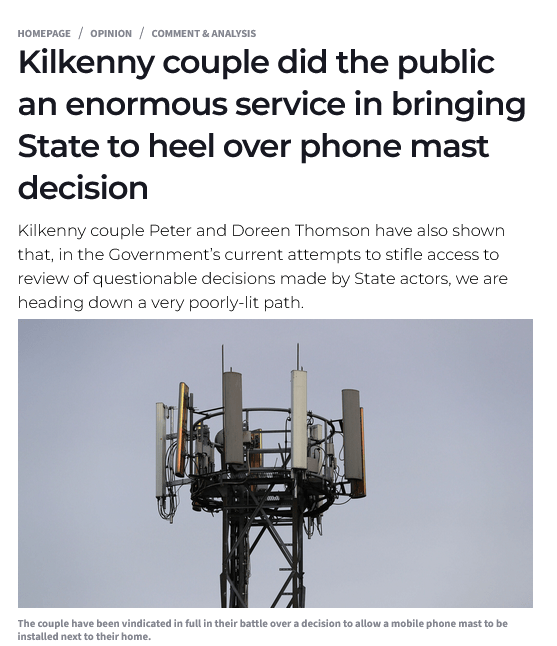
A Co Kilkenny couple has won a landmark decision in the Supreme Court ensuring they can challenge an An Bord Pleanála decision to allow a mobile phone mast to be built beside their property.

Peter Thomson and his wife Doreen had initially objected to the construction of the mast adjacent to their home in Kells alleging that the decision to grant permission had been affected by “bias”.

That objection was dismissed by the High Court as being made outside the time limit of eight weeks for taking a legal action, only for that decision to be overturned by the Court of Appeal.

An Bord Pleanála subsequently appealed that decision to the Supreme Court with arguments being heard from both sides in January of this year.

The latest unanimous decision by the five justices of the higher court means that the Thomsons’ objection can finally be heard in the High Court.

The couple’s case had alleged the statistical probability was zero that An Bord Pleanála’s former deputy chair Paul Hyde — one of nine board members at the time — would have been allocated 42 out of 49 mast applications by Eircom in less than two years.

Mr Hyde had approved the 15m-tall mast beside the Thomsons’ property against the advice of his own planning inspector, Philippa Joyce, in June 2021.

In May 2022, the Irish Examiner first reported Mr Hyde had overruled his own planning inspectors’ recommendations for refusal of mast applications in 86% of cases over a 20-month period up to May 2022 — roughly eight times the average for such an occurrence.

Although evidence of alleged irregularities in the decision-making of Mr Hyde became public knowledge in May 2022, the Thomsons did not take their action until November — six months later — with Peter Thomson’s submission to the court stating he had feared “an adverse costs order”.

Mr Hyde eventually resigned from An Bord Pleanála before being criminally convicted of making false or misleading declarations regarding his own assets in 2023.

In the unanimous judgement for the Supreme Court dismissing the board’s appeal, Justice Seamus Woulfe agreed with the Court of Appeal that the public interest of seeing the Hyde decisions tested in court should outweigh in importance the need for the commercial certainty provided by decisions made by the planning body being guaranteed to stand once the statute of limitations had expired.

He noted that the allegations made by the Thomsons “go far beyond the facts of one individual planning decision, and involve systemic issues about the operation of the board over a number of years and the integrity of the planning regime in this jurisdiction”.

Reacting to the decision solicitor Eoin Brady, a partner at FP Logue Solicitors who acted for the Thomsons for the case’s duration, said that it was “a welcome confirmation from the Supreme Court of the critical importance of the integrity of the planning system”.

“When there are questions over the integrity and objectivity of our national planning institutions, it results in a significant corrosion of public confidence which ultimately undermines democracy,” Mr Brady said, adding that the decision “reflects the importance of the public interest in the integrity of our planning system”.

https://www.irishexaminer.com/news/arid-41668781.html?fbclid=IwY2xjawLksRxleHRuA2FlbQIxMQABHqE0nOeQlIWQncsCws6ZK4g-0_iwujcGiTOPNURV3bBCgQVQpagi1rLcIMa8_aem_Jm1MEE—yZpq0UARvO0Qw

Posted in Uncategorized | Comments Off on Supreme Court upholds Kilkenny couple’s objection to construction of mobile phone mast

A comprehensive mechanism of biological and health effects of anthropogenic extremely low frequency and wireless communication electromagnetic fields

Front. Public Health, 04 June 2025  Sec. Radiation and Health 

Volume 13 – 2025 | https://doi.org/10.3389/fpubh.2025.1585441 

Dimitris J. PanagopoulosIgo, r Yakymenko, Geoffry N. De Iuliis, George P. Chrousos

Posted in Uncategorized | Comments Off on A comprehensive mechanism of biological and health effects of anthropogenic extremely low frequency and wireless communication electromagnetic fields

Study concludes Abnormal Blood Clumping after just 5 Minutes of Exposure to Cellphone Radiation

Robert R. Brown

https://doi.org/10.1080/00139157.2025.2471222

Brown, R. R. (2025). Hypotheses and Images: Cellphone Radiation and Clumping Blood. Environment: Science and Policy for Sustainable Development, 67(3), 57–60

EXCERPT

Assessing human health risks from environmental exposures remains a vexing challenge. Experiments on cell cultures (in vitro) or living animals (in vivo) are employed to predict damage to human health. In vitro tests are increasingly questioned for their relevance to human health.

Researchers have described an abnormal response in the blood termed the rouleaux phenomenon for people exposed to cellphone or Wi-Fi router radiofrequency radiation (RFR). Rouleaux is an atypical condition where red blood cells adhere to each other, yielding a clump or cluster resembling a stack of coins. Until now, the diagnosis of rouleaux by researchers has been based on an in vitro technique involving evaluation of stained blood from living animals or humans through “live blood cell analysis with dark field microscopy.” This technique is subject to two types of artifacts: misinterpretation of the sample, or because there are blood clumps from improper preparation rather than from exposure to radiofrequency radiation.

As a diagnostic radiologist with decades of experience evaluating blood flow with ultrasound, I realized ultrasound technology could diagnose red blood cell clumping from radiofrequency radiation in dynamic real time, in vivo. During ultrasonography, rouleaux formation has a well-recognized appearance, and is associated with infectious and inflammatory processes, connective-tissue diseases, some forms of cancer, and other health conditions.

A colleague and I carried out a study on a healthy volunteer, recently published in Frontiers in Cardiovascular Medicine. We showed that just 5 minutes of direct exposure to an operating cellphone in contact with the skin surface behind the knee (see Supplemental Videos Links, page 57) produced rouleaux formation in the popliteal vein.

The blood vessel in this location, the popliteal vein, is easy to see because it is large and close to the skin surface. Our subject initially had a normal-appearing vein on ultrasound, meaning there was nothing visible inside of the vessel. A normal vessel’s interior (arrows) appears black on ultrasound because there are no reflections of sound occurring from within the vessel.

Normal ultrasound appearance of the popliteal vein, arrows indicate blood vessel interior.

For a structure to create a white dot or reflection of sound, that is, an “echo” on ultrasound, it needs to be of sufficient size. The detectable size is determined when the technologist chooses a probe that emits a certain frequency or frequency range depending on how deep into the body they want to see. The lower the frequency, the more deeply the sound travels, but the probe will only detect larger things.

We used a linear 2–9 MHz transducer for the vascular ultrasounds. Frequencies between 2 and 9 MHz only detect structures larger than 154 microns.

Although rouleaux formation is usually reversible in healthy persons, meaning the blood will return to normal over time, there are reports that rouleaux may increase one’s risk for developing a larger blood clot, which could then lead to a potentially fatal pulmonary embolism or stroke.

Our findings help confirm that radiofrequency radiation emitted by a cellphone, and most likely other electronics utilizing wireless communication, creates potentially damaging physiological effects at exposure levels significantly lower than the commonly accepted safety level. Although such effects have been described by hundreds of researchers, they have been discounted by industry and regulatory agencies, who rely on determinations of specific absorption rate, SAR, for safe exposure limits. This study presents a visible manifestation of at least one phenomenon occurring within current SAR exposure levels. Regulatory reliance on SAR has led us down a dangerous path impacting human and environmental health.

READ FULL ARTICLE WITH IMAGES AND VIDEOS https://www.tandfonline.com/doi/full/10.1080/00139157.2025.2471222

Posted in Uncategorized | Comments Off on Study concludes Abnormal Blood Clumping after just 5 Minutes of Exposure to Cellphone Radiation