FREE WEBINAR, Weds, 30th September (6pm) : Dr Ronald Melnick – Wireless Device Emissions: Inadequate Exposure Limits for Cancer & Reproductive Risks

Expert Webinar. 30th September, 6pm Irish time

Ronald Melnick, PhD served as a scientist for 28 years at the U.S National Toxicology Program (NTP) at the National Institute of Environmental Health Sciences.

Register for free https://us02web.zoom.us/webinar/register/WN_m5FWG3XvStSWMJMj7zyq2A#/registration

https://icbe-emf.org/webinar-cell-phones-and-wireless-why-current-exposure-limits-may-not-protect-against-cancer-and-reproductive-harm/

Posted in Uncategorized | Comments Off on FREE WEBINAR, Weds, 30th September (6pm) : Dr Ronald Melnick – Wireless Device Emissions: Inadequate Exposure Limits for Cancer & Reproductive Risks

Italian Supreme Court Strengthens Consumer Right to Know on Phone Safety (Cassazione 24015/2026)

Source Article: Environmental Health Trust

Italy’s Supreme Court Strengthens Consumer Rights on Cell Phone Safety.

On July 24, 2026, Italy’s Corte di Cassazione (Supreme Court) handed down a ruling that strengthens consumer rights around cell phones and a wide range of other technology. The case, Briganti v. Apple, was brought by an Italian woman who purchased an iPhone in 2016 and asserted that Apple had failed to give her adequate information or to recommend precautions about possible risks of extensive iPhone use and related exposure to radiofrequency emissions. Italian lawyer Fabio Cardanobile successfully argued that consumer information is itself a legally protected right — meaning that even if scientific evidence concerning health effects is not yet conclusive, consumers should receive relevant information that allows them to make informed choices about how they use a product.

While the Cassazione did not rule that iPhones are dangerous, it did establish a precedent that scientific uncertainty is not a good enough reason for a manufacturer to say nothing. The court’s ruling was that if there is credible information suggesting a potentially significant risk which an ordinary consumer cannot reasonably perceive for themselves, the manufacturer may have duties to provide information that enables the consumer to make an informed decision.

The ruling determined that withholding relevant risk information could potentially constitute compensable damage even without proof that the consumer actually developed a disease, because withholding information impairs the consumer’s autonomy and ability to make an informed choice. The court also indicated that preventive remedies could sometimes be imposed, with examples being additional warnings, corrective information, and accessories that could reduce exposure. The legal remedy therefore might be to inform consumers better and change how the product is presented rather than simply paying damages after the fact.

The court’s full order includes several landmark points that could influence any number of lawsuits and regulations going forward. These points include:

• Professional diligence requires more than regulatory minimums. The order makes the point that a product can comply with current technical standards and yet still be legally defective if it lacks adequate warnings or instructions about risks that consumers cannot readily perceive.

• Scientific uncertainty does not eliminate the duty to warn. If credible scientific evidence suggests a plausible health risk, a manufacturer may have duties to inform consumers and reduce exposure even if a causal relationship has not been conclusively established.

• The Court emphasized the ALARA approach (“as low as reasonably achievable”). With regard to cell phones, this refers to ways consumers may reduce radiofrequency exposure, for example by increasing distance from the body. The order emphasizes that “the ALARA principle does not presuppose a finding of certain harmfulness, but is founded precisely on the scientific plausibility of the risk and on the need to prevent its possible materialization… The application of the ALARA principle translates into an obligation to inform the consumer of the manner of use suitable to reduce exposure, enabling him or her to knowingly modulate his or her own conduct.”

The Cassazione’s ruling overturns a lower court’s reasoning and remands the case to a differently constituted Court of Appeal for reconsideration, with instructions to examine whether the consumer might have changed her behavior had she been properly informed. The remand court must determine whether Apple actually fulfilled its information and precautionary obligations and whether any harm or preventive remedy follows…..

Sources:  

  1. Ordinanza Briganti c. Apple Corte Cassazione
  2. https://ntplusdiritto.ilsole24ore.com/art/iphone-apple-puo-rispondere-dell-omessa-informazione-rischi-radiofrequenze-AJawUFX
  3. https://radiationresearch.org/italian-supreme-court-strengthens-consumer-right-to-know/
  4. https://phonegatealert.org/en/iphone-health-risks-italian-supreme-court-ruling/
  5. https://levaudsansantennes.ch/2026/07/30/phonegate-apples-iphone-italian-supreme-court-ruling/

COURTS FULL ORDER: 

https://ehtrust.org/wp-content/uploads/Ordinanza-Briganti-c.-Apple-Corte-Cassazione.docx.pdf?emci=799d6aff-42a6-f111-9b33-0022482a9a8d&emdi=ba05ac0f-cca7-f111-9b33-0022482a933b&ceid=8500085

Posted in Uncategorized | Comments Off on Italian Supreme Court Strengthens Consumer Right to Know on Phone Safety (Cassazione 24015/2026)

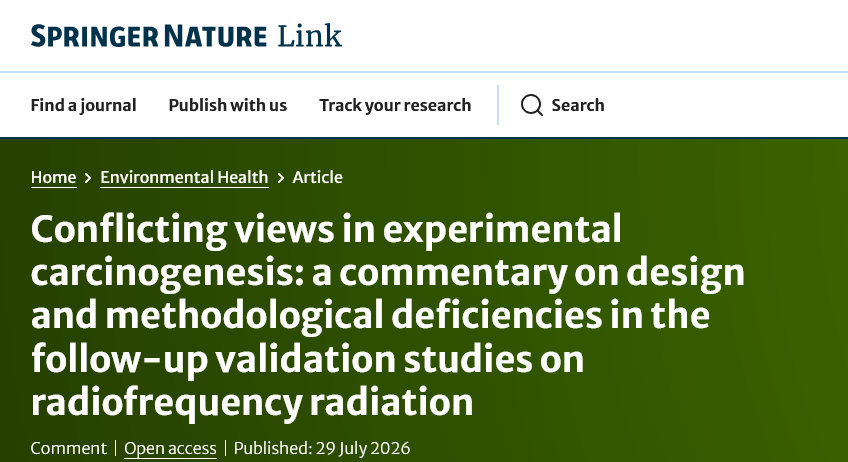
Conflicting views in experimental carcinogenesis: a commentary on design and methodological deficiencies in the follow-up validation studies on radiofrequency radiation

Melnick, R.L., Moskowitz, J.M., Héroux, P. et al. Conflicting views in experimental carcinogenesis: a commentary on design and methodological deficiencies in the follow-up validation studies on radiofrequency radiation. Environ Health 25, 66 (2026). https://doi.org/10.1186/s12940-026-01324-5

29 July 2026

Abstract

Conflicting views in experimental carcinogenesis often arise due to differences in study design among reported studies. For carcinogenicity assessments, regulatory agencies, such as the US Food and Drug Administration (FDA), and intergovernmental advisory organizations, such as the Organization for Economic Co-operation and Development (OECD), specify the use of at least three dose levels plus control group for trend analyses, with the highest dose inducing a measurable toxic response. In addition, there needs to be a sufficient number of animals per group to have adequate power to detect a true carcinogenic effect. Departure from such recommendations can weaken the interpretations of study results. We examine here two recent carcinogenicity studies from Japan and Korea that were conducted following the positive carcinogenicity study of radiofrequency radiation (RFR) in experimental animals by the National Toxicology Program (NTP). The Japan and Korea follow-up studies used fewer animals per group, a single RFR exposure group, and a lower exposure level than the NTP study. Not surprisingly, while the NTP study revealed the carcinogenicity of RFR, the Japanese and Korean studies, which had reduced statistical power compared to the NTP study, issued conclusions conflicting with those of the more substantial NTP study on the health effects of RFR. In general, carcinogenicity studies with weaker doses, fewer exposure groups, and reduced statistical power should not be used to test the validity of more robust studies.

READ FULL ARTICLE HERE https://link.springer.com/article/10.1186/s12940-026-01324-5

Posted in Uncategorized | Comments Off on Conflicting views in experimental carcinogenesis: a commentary on design and methodological deficiencies in the follow-up validation studies on radiofrequency radiation

CHILDREN NEED GREATER PROTECTION – Safeguarding Children’s Health in the Digital Age: Addressing Screen Time, Wireless Radiation & ELF/EMF

The International Commission on the Biological Effects of Electromagnetic Fields is calling on governments, schools and the wireless industry to work together to reduce kids’ exposure to electromagnetic fields (EMFs). The consortium of scientists and doctors issued a 23-page statement, which cited over 100 published scientific studies documenting how EMFs at levels currently allowed by the FCC can harm human health. Children are especially vulnerable, the group said.

A Position Statement on Children’s Health and Electromagnetic Fields by the International Commission on the Biological Effects of Electromagnetic Fields

September 9, 2026 

https://icbe-emf.org/wp-content/uploads/2026/09/ICBE-EMF-Child-Health-Cell-Phone-Cell-Tower-EMF-Position-Statement-PDF-982026-1.pdf

Posted in Uncategorized | Comments Off on CHILDREN NEED GREATER PROTECTION – Safeguarding Children’s Health in the Digital Age: Addressing Screen Time, Wireless Radiation & ELF/EMF

Remembering Nearfield – An Animated Film about EHS by Sean T Carney (2023)

WORLD EHS DAY 16th JUNE 2026

(Some viewers might experience discomfort with the lighting through the film)

Film Synopsis:

Tragically losing everything as her health mysteriously declines, a successful wife and entrepreneur devoted to her family and business finds herself alone, vulnerable and unable to function in society. A startling series of events and a final, uncomfortable diagnosis reveal the essential problem that must be addressed.

Exposure to wireless radiation during her career triggers a tipping point. Ill health and impairments continue, because she’s over-sensitised to man-made electromagnetic fields (EMFs) in the environment. The sense of her disabling sensitivity being a taboo in our society and the resulting stigma attached to her health issue, electrohypersensitivity (EHS), are shocking – showing us how 5% of the population struggle to have rights or a voice because this vulnerability to environmental EMFs isn’t adequately addressed, nor widely recognised.


This all has consequences as her snowballing crisis brings into sharp focus. In this revealing animated film we glimpse the social exclusion, the deep anxieties, the sense of vulnerability and search for remedy as we are absorbed into the world of the protagonist.

We are brought face to face with a woman who is like everybody else – because she had been convinced that illness caused by wireless radiation in her environment was “crazy” and so could never have happened to her.
 We are reminded how we’re all taking our chances with our health, just like she did, when we surround ourselves with wireless radiation.


Why does this story need to be told? Society isn’t adequately informed about EHS. Real life testimonies improve our understanding. This film is narrated by a woman with EHS showing us her experiences, which, described through sensitive, informative animation, educates on many levels, challenging misunderstanding and discrimination. Her testimony is important because inaccessibility and discrimination are prohibited by international law – she is an equal citizen and her rights should be protected, like everybody else.

This story seeks to change attitudes, to promote positive awareness and inclusion. Better recognition of EHS is vital when there is little help or acceptance for her, or others with EHS. This debilitating environmental intolerance implies wireless technologies can be harmful to us – something the population is not comfortable with. Her story raises crucial questions about human rights, functional diversity and health, and ultimately her situation points to realities and implications we cannot ignore, no matter how inconvenient.

“With Increasing Frequency This Urgent Message Resonates Around The World”

Description:

This is an IMDb listed multi-award-winning film about disability with a mission to start a brave new global conversation to break taboos, change attitudes, and catalyse formal international recognition of Electromagnetic Hypersensitivity (EHS) as a disability for a more inclusive and healthier world. This short animated film about electromagnetic hypersensitivity (EHS) is narrated by Corriëlle van Vuuren who has EHS, and features supporting narration by Kate Kheel.

Key stats: 8944 views from 2023 to Dec 2025. Viewer stats restarted in Jan 2026. This film has been screened globally, and selected 56 times by International Film Festivals from 2023 – 2026. It has won 17 awards including Best Health Film (2023), Best Social or Environmental Theme in Animation (2026) and Best Film on a Disability Issue (2024). See the Official Trailer’s show notes for more details.

It is “Yellow June” which brings visibility, recognition, and compassion to people with Electromagnetic Hypersensitivity (EHS) who are affected by electromagnetic pollution, and focuses on World EHS Day on June 16th. Remembering Nearfield stands with Coeurs d’EHS, Europeans for Safe Connections, Safe Tech International and Electrosensitivity-UK this World EHS Day as gatherings and awareness-raising events unfold around the world throughout the Summer.

Remembering Nearfield is a film about Electromagnetic Hypersensitivity (EHS), a health condition that now affects over 5% of the population and hopes to catalyse global recognition of this debilitating condition.

A press release on the film’s association with World EHS Day can be accessed here:

https://esc-info.eu/world-ehs-day-embraces-remembering-nearfield/ (EU press release)

https://safetechinternational.org/world-ehs-day-embraces-remembering-nearfield/ (UK/US)

Find out more about Yellow June, here: https://esc-info.eu/yellowjune/

Posted in Uncategorized | Comments Off on Remembering Nearfield – An Animated Film about EHS by Sean T Carney (2023)

Public Consultation on Government Digital Wallet – closed tomorrow 24th JUNE at 5pm

The closing date for public consultation on the proposed Government Digital Wallet is tomorrow Wednesday 24th June, at 5pm.

A consultation was published on the government website and circulating online in April but it had no closing date. It looks like it was a test or development of the consultation, as a month later the Gov.ie website shows that the consultation was launched and open for submissions on 13 May 2026 – this time with a closing date and also appears to have additional questions.

Will any submissions that members of the public made before the 13th May be accepted?

UPDATE 24/6: After contacting Dept they confirmed that the consultation was posted on 3 April and updated on 13 May, and that all submissions made from 3rd April are accepted. They also advised that there had not been any substantive changes to the questions or additional questions added since 3 April.

Consultation:

https://www.gov.ie/en/department-of-public-expenditure-infrastructure-public-service-reform-and-digitalisation/consultations/consultation-on-the-government-digital-wallet/#the-eidas-regulation

Posted in Uncategorized | Comments Off on Public Consultation on Government Digital Wallet – closed tomorrow 24th JUNE at 5pm

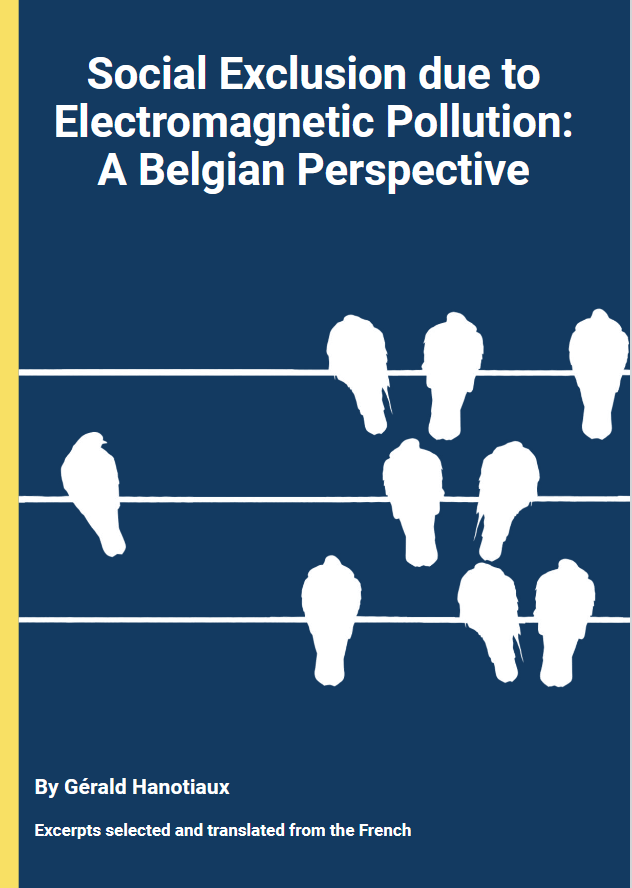
Booklet: Social Exclusion Due To Electromagnetic Pollution (A Belgian Perspective) – Part 2: Viewpoints from Doctors, an Industry Spokesman and a Politician

With thanks to Belgian journalist Gérald Hanotiaux and Electrosensitivy UK for publishing these two excellent booklets, Part 1 in 2024, and Part 2 in June 2026.

The booklets can be downloaded and printed, or booklets purchased from ES-UK. More information https://www.es-uk.info/

Part 2: https://www.es-uk.info/wp-content/uploads/2026/06/ES2_WEB_260515.pdf

Part 1: https://www.es-uk.info/wp-content/uploads/2024/09/ES_WEB_240908.pdf

Posted in Uncategorized | Comments Off on Booklet: Social Exclusion Due To Electromagnetic Pollution (A Belgian Perspective) – Part 2: Viewpoints from Doctors, an Industry Spokesman and a Politician

Online International Presentation for people with MCS and EHS – 24th June at 6pm

COALICIÓN NACIONAL DE FM, SFC, EHS y SQM

Message from Olle Johansson

Dear Mailing List Members,


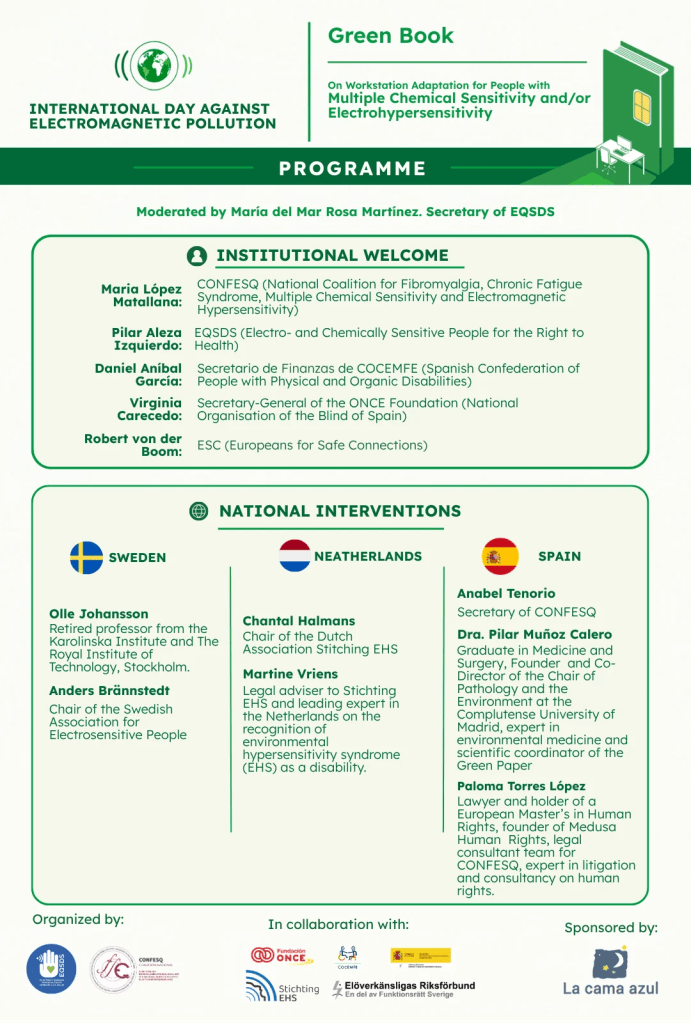
Please, find below a very important invitation from several Spanish disability organizations on the occasion of the International Day Against Electromagnetic Pollution, headed by the CONFESQ [the National Coalition of Organizations for Fibromyalgia, Chronic Fatigue Syndrome, Electromagnetic Hypersensitivity, and Multiple Chemical Sensitivity] which will present its Green Book on Workplace Adaptation for People with Multiple Chemical Sensitivity and/or Electrohypersensitivity in an international online event on June 24 at 18:00 (CEST).


Scroll down for all the practical details!
With my very best regards

Yours sincerely

Olle

(Olle Johansson, associate professor)

CONFESQ and EQSDS invite you to the international presentation of the Green Book: On Workstation Adaptation for People with Multiple Chemical Sensitivity and/or Electrohypersensitivity
Date: June 24 Time: 18:00 (CEST)Format: Online Language: English, with optional multilingual subtitles
On the occasion of the International Day Against Electromagnetic Pollution, CONFESQ will present its Green Book on Workplace Adaptation for People with Multiple Chemical Sensitivity and/or Electrohypersensitivity in an international online event on June 24 at 18:00 (CEST). This webinar, which will be conducted in English with posibility of multilingual subtitles, will contribute to raising awareness of the situation of Electrohypersensitivity at an international level, taking as a reference countries such as Sweden, where EHS was recognised as a disability in 2000, and the Netherlands, where recognition was achieved in 2023, in order to analyse progress and promote its development in other contexts.
Registration
The event will be accessible through two modalities:

Zoom (registration required): access to the live session with multilingual subtitles. Register here: https://us06web.zoom.us/meeting/register/y4wD_NI6TsW-zYfZRzeoXQ . Once registered, participants will receive access to the Zoom session.

YouTube (open access): live streaming available on CONFESQ’s YouTube channel with Spanish subtitle: https://youtube.com/live/41aTAV4AgOk
Posted in Uncategorized | Comments Off on Online International Presentation for people with MCS and EHS – 24th June at 6pm

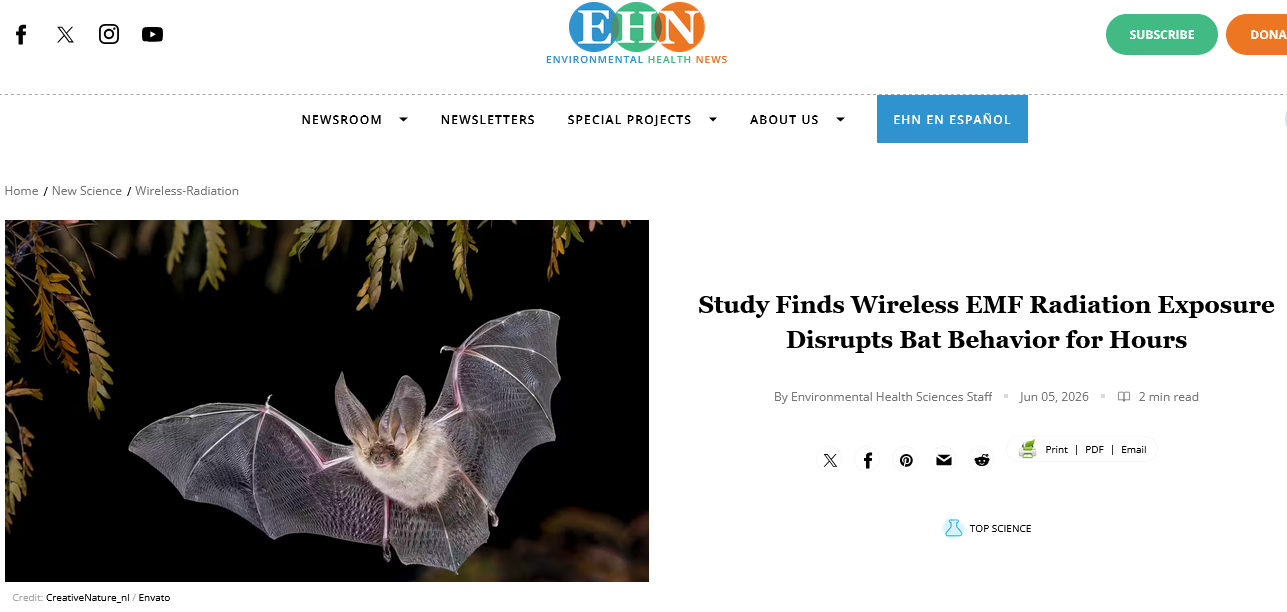
Study Finds Wireless EMF Radiation Exposure Disrupts Bat Behaviour for Hours

Source Article: Environmental Health News https://www.ehn.org/wireless-emf-radiaton-bat-behavior

A recent study published by Lindecke et al. in Science found that brief exposures to wireless radiofrequency (RF) radiation, a type of electromagnetic field (EMF), disrupted flight navigation in bats for several hours beyond the exposure period.

In short:

  • Bats exposed to RF radiation consistently flew in random directions, rather than the normal directional behavior of the nonexposed controls.
  • This disorientation was reproducible and occurred regardless of the timing of exposure, lasting for several hours after exposure ended.
  • The authors state artificial EMF may act as “a stressor for wildlife” as effects occurred at levels within the human safety thresholds for RF radiation exposure set by the International Commission for Non-Ionizing Radiation Protection (ICNIRP).

Key quote:

“The widely anticipated increase of electromagnetic pollution as a consequence of urbanization trends and global proliferation of wireless technology may further add to the effects of anthropogenic climate change and land conversion by disrupting migratory movements of wildlife.”

….

Read EHN article here: https://www.ehn.org/wireless-emf-radiaton-bat-behavior

See also: Microwave News ‘Two Remarkable New Findings on Magnetic Navigation‘ https://microwavenews.com/papers/two-remarkable-new-findings-magnetic-navigation

Posted in Uncategorized | Comments Off on Study Finds Wireless EMF Radiation Exposure Disrupts Bat Behaviour for Hours

Request for an EU Regulation Explicitly Guaranteeing the Right to Analogue (Non-Digital) Access to Essential Services – Petition by Europeans for Safe Connections

Source: Europeans For Safe Connections https://esc-info.eu/request-for-an-eu-regulation-explicitly-guaranteeing-the-right-to-analogue-non-digital-access-to-essential-services/

28 January 2026

….

Read full petition and article here https://esc-info.eu/request-for-an-eu-regulation-explicitly-guaranteeing-the-right-to-analogue-non-digital-access-to-essential-services/

Posted in Uncategorized | Comments Off on Request for an EU Regulation Explicitly Guaranteeing the Right to Analogue (Non-Digital) Access to Essential Services – Petition by Europeans for Safe Connections