
SOURCE: An Scéal 10th December 2019
5G & WiFi Concerns and Precautions. David Sullivan
Listen here : https://ansceal.ie/2019/12/10/5g-wifi-concerns-precautions/
SOURCE: An Scéal 10th December 2019
Listen here : https://ansceal.ie/2019/12/10/5g-wifi-concerns-precautions/
https://doi.org/10.1111/coep.12456
We investigate the relationship between cell phones and brain cancer using brain cancer death rates for 88 countries between 1990 and 2015 from the World Health Organization and country‐level mobile phone subscription rates from the World Bank. We estimate difference‐in‐difference models including country and year fixed effects and time‐varying country covariates. We find that mobile phone subscription rates are positively and statistically significantly associated with death rates from brain cancer 15–20 years later. In falsification tests, we find few positive associations between mobile phone subscription rates and deaths from rectal, pancreatic, stomach, breast or lung cancer or ischemic heart disease. Finally, differential effects models suggest that mobile phone subscription rates are associated with brain cancer deaths 15–19 years later relative to deaths from other causes. (JEL I15, O33)
Smartphones, tablets, smart watches, fitbits, drones, virtual reality headsets, wireless earphones, Airpods and wifi enabled toys and gadgets expose your child to harmful microwave radiation. Children are more vulnerable to adverse health effects as they absorb more radiation than adults.
Read More Here: Fact-Sheet-Compilation-Holiday-Alert.pdf

Prof. Olle Johansson – Adverse Health Effects of Artificial Electromagnetic Fields:
Prof. Tom Butler – What does Science say about Risks of Wireless technologies:
SOURCE ARTICLE : EURACTIV
12the December 2019
The European Commission is “irresponsible” in not addressing the health risks associated with the future rollout of next-generation mobile network, Bulgarian MEP Ivo Hristov has said.
His comments echo concerns recently highlighted by EU telecoms ministers, related to “non-technical” elements of 5G cybersecurity, as the debate continues around Europe’s ability to keep pace with the rest of the world on 5G deployment.
However, discussion over the potential health risks of establishing denser network infrastructures consisting of considerably higher capacities has recently surfaced as a growing concern among Parliamentarians in Brussels.
Speaking at an event at the European Parliament on Tuesday (10 December), S&D’s Hristov hit out at the Commission for failing to conduct a health impact assessment report on 5G, despite warnings being highlighted by many in the scientific community.
“Currently the EU has no assessment of the human health risk of the introduction of 5G technology,” he said. “The European Commission took the position that such an assessment was not necessary, despite warnings of the scientific community. I find this irresponsible.”
He added that he has asked the Parliament’s Science and Technology Options Assessment (STOA) Panel to prepare a study of the potential effects on health and the environment from the introduction of 5G networks.
Hristov’s point was supported on Tuesday by a contingency of Green MEPs who came out in force to challenge various telecom industry representatives, keen on making sure that Europe doesn’t lag further behind in its deployment of 5G network infrastructure.
5G technologies were described as an “inevitability” by Prof. Vladimir Poulkov, head of the intelligent communications infrastructure R&D Laboratory at Sofia Tech Park.
Poulkov said there were “forces at play” that would mean 5G deployment in the EU would become a necessity in order to keep up with the demand for higher capacity data transfers and speeds, something, he said, may help with wider goals in reducing Europe’s energy consumption.
This point in particular was heavily refuted by Paul Lannoye, former MEP and chairman of the Environmental Group Grappe, who claimed that there are no benefits whatsoever to the application of 5G in the energy sector.
In terms of the environment, Lannoye referred to several scientific studies that claim radio waves emitted from 5G transmitters could negatively impact insect populations, causing disruption to natural ecosystems.
Along this axis, German Green MEP Klaus Buchner was keen to highlight the importance that the EU follow its own commitments in exercising the ‘precautionary principle’ with regards to the future deployment of 5G across the bloc, which involves potentially taking preventive action in the face of uncertainty or possible risk.
Enshrined in Article 191 of the Lisbon Treaty, the EU’s precautionary principle states that “environmental damage should as a priority be rectified at source.”
In 2016, the European Commission put forward plans to provide an EU-wide commercial launch of commercial 5G by 2020, with additional targets to cover urban areas by 2025.
However, these plans have faced a series of potential setbacks, thus far principally concerning the security of 5G network infrastructure, and allowing third-party access to the bloc’s next-generation telecommunications networks.
Last week, EU ministers adopted conclusions concerning the importance and security of 5G technology, stressing that an approach to 5G cybersecurity should be comprehensive and risk-based, while also taking into account ‘non-technical factors’.
Europe currently finds itself under pressure to take a stance on the involvement of China’s Huawei in the EU’s 5G networks. The US has already signed agreements with several EU member states including Poland and Romania, stressing that they will work together on a 5G approach.
Meanwhile, Bulgaria Prime Minister Boyko Borissov has recently met with US President Donald Trump in Washington, and the two released a joint statement saying that the “United States and Bulgaria declare the shared desire to strengthen cooperation” in the field of 5G.
More broadly, in order to reach Bulgaria’s 2023 targets for connectivity and e-government, the country’s Minister of Transport, Information Technology and Communications, Rosen Zhelyazkov, recently said that people need to be won around on some of the issues currently holding up the wider rollout of 5G infrastructures, such as security and health.
For Bulgarian MEP Hristov, however, these issues should be at the top of the list.
“It is the irreversibility of the process that should cause us to pay attention to fifth-generation mobile networks,” he said on Tuesday. “Along with the numerous advantages, I believe that we should pay serious attention to the possible risks related to cybersecurity and potential effects on the environment and human health.”
For the Commission at least, it appears that security rather than health is the most important issue.
An October report from the Commission about the coordinated risk assessment of 5G networks noted that “threats posed by states or state-backed actors are perceived to be of highest relevance,” and member states have now been tasked with working on a set of risk alleviating measures to mitigate the cybersecurity risks outlined in the report.
EU nations will work alongside the Commission and ENISA, the European Agency for Cybersecurity, in the drawing up of the plans, which are set to be ready by the end of December this year.
[Edited by Zoran Radosavljevic]
SEE ORIGINAL ARTICLE HERE
SOURCE ARTICLE : IRISH EXAMINER
Local residents in the Cork village of Watergrasshill have emerged victorious in a planning row over a telecommunications mast located within a few metres of their homes.
A ruling by An Bord Pleanála means telecom firm, Three Ireland, could face enforcement proceedings unless it removes the unauthorised 30-metre mast and associated equipment including a security fence from its location at Bishop’s Island in Watergrasshill.
It follows the decision of the board to uphold the appeal of local people against the decision of Cork County Council in July to grant retention planning permission for the mast.
An Bord Pleanála said guidelines on the location of telecom antennae and support structures published by the Department of the Environment in 1996 made it a requirement that free standing masts should only be located in the immediate surrounds of villages “as a last resort”.
In addition, the board pointed out that the guidelines stated that masts should also only be located as a last resort in a residential area if alternative sites were either unavailable or unsuitable.
“It is considered that the proposed development would constitute a highly obtrusive development immediately abutting established housing within the village of Watergrasshill,” the board ruled.
It said the mast would also have a significant overbearing impact on nearby homes and would “contribute substantially to the erosion of the visual amenities of residents at this location.”
Cork County Council has granted retrospective permission for the mast on the basis it had been in use for over 20 years and recognising the importance of providing modern telecommunications across the country.
Temporary retrospective permission for the mast had previously been granted in 2011 but it expired in July 2018.
Council planners also considered that the location was not of high landscape value and that the retention of the mast would not unduly compromise the visual character of the area despite the proximity of almost 40 residential units.
One objector who lives close to the mast in the Glen Dara estate said it was a considerable eyesore and visually obtrusive.
Tarak Ben Amor claimed there was a constant buzzing noise from the mast and from the fans of associated equipment and he believed it was dangerous and a health risk, especially to young children.
Mr Ben Amor said he had taken radiation measurements from the mast and found them to be way above recommended limits – a claim disputed by Three who said it was compliant with international guidelines on exposure to electro-magnetic fields.
The company had argued that telecom masts were frequently located in close proximity to housing, particularly in urban areas.
Three claimed a growth in the number of houses in Watergrasshill further justified the need to retain the structure as there was an increased demand for telecom services in the area.
It also stated the loss of the site would create significant coverage difficulties for three mobile phone operators and would possibly require the need for additional masts around Watergrasshill.
Three said it had investigated complaints about noise from the mast and adjustments were made with subsequent readings not exceeding recommended levels.
The company promised it would carry out landscaping work around the site to mitigate any perceived negative visual impact it was having.
However, an inspector with An Bord Pleanala said significant residential development had taken place in the immediate vicinity of the mast since it was previously granted planning permission eight years ago.
“It has developed from being a rural area to now distinctively forming a growing residential suburb of Watergrasshill,” the inspector observed.
He added: “Unquestionably, in my opinion, there is an unacceptable overbearing impact.”
The inspector said Three Ireland had also failed to address the issue of alternative sites in its application for retention permission.
He concluded that the existence of the mast was also likely to have an adverse impact on property values in the area.
SOURCE ARTICLE : REUTERS WASHINGTON
By Lawrence Hurley
WASHINGTON (Reuters) – The U.S. Supreme Court on Monday rejected a free speech challenge brought by a trade group against a regulation issued by the California city of Berkeley that requires cell phone retailers to tell customers of certain radiation risks.
The justices left in place a July 2019 decision by the San Francisco-based 9th U.S. Circuit Court of Appeals that refused to block the 2015 regulation that industry group CTIA appealed.
CTIA said the regulation violates the First Amendment to the U.S. Constitution, which protects free speech rights, because the government, without the necessary justification that supports other types of regulations, is forcing retailers to spread a message they disagree with.
The 2015 regulation requires retailers to provider a notice to customers saying that carrying a cell phone can exceed Federal Communications Commission guidelines for exposure to radio-frequency radiation.
“If you carry or use your phone in a pants or shirt pocket or tucked into a bra when the phone is ON and connected to a wireless network, you may exceed the federal guidelines,” the notice says.
CTIA disputed the content of the notice, saying it is misleading because the FCC has concluded that carrying a cell phone is safe.
Read more on the 5 year battle https://mdsafetech.org/2019/07/05/berkeley-cell-phone-warning-ordinance-upheld-by-us-federal-appeals-court/
SOURCE ARTICLE : ENVIRONMENTAL HEALTH TRUST
Greece: The Kalamata City Council decided not to continue the 5G pilot program after a three hour debate.
“The City decided not to renew the contract with the telecommunications company- a contract originally signed for the development of a 5G Pilot program. This is a result of a 6 month effort made by the people of Kalamata to stop the 5G deployment in their town,” stated Dr. Theodore Metsis who has been presenting across the country on the environmental and human health issues posed by 5G.
News coverage: “The city council decided to suspend 5G in Kalamata”
CNN Greece News Coverage Kalamata: “Experiment with the Kalamatians’ Guinea Pigs” – “Block” on 5G Network by the Municipality
Video of the meeting at the Kalamata City Council.
Kalamata was the first City in Greece to install 5G. Watch a video from earlier this year when they celebrated the pilot program.
ORIGINAL ARTICLE : PHONEGATE ALERT.ORG 18th November 2019

In July 2019 (updated in September 2019), the French Public Health Agency “Santé Publique France“, together with the Francim cancer registries, the Hospices Civils de Lyon and the Institut National du Cancer, published national estimates of cancer incidence and mortality in metropolitan France between 1990 and 2018. These are based on the modeling of observed incidence data (new cases) until 2015 by cancer registries, supplemented by projections until 2018.
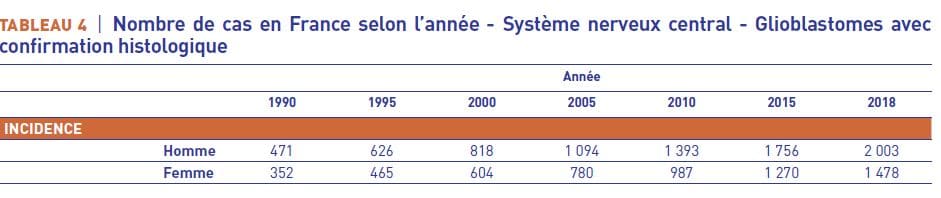
Volume 1 of the report is devoted to solid tumors (27 tumors and 22 subtypes). Between 1990 and 2018, the overall incidence rate of solid tumors remained relatively stable in men and continued to increase in women. At the same time, the annual number of new cases of glioblastoma with histological confirmation (one of the most aggressive types of brain cancer) has increased fourfold and more for both sexes.
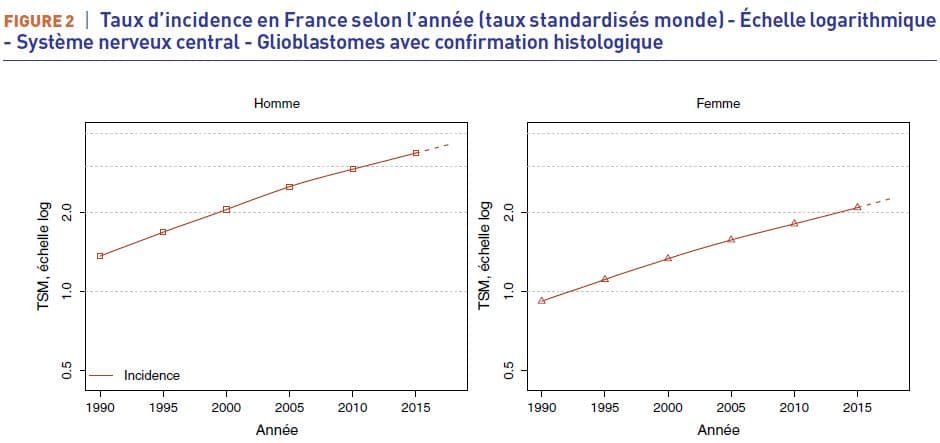
Santé Publique France estimates that there will be 3,481 new cases of these glioblastomas in metropolitan France in 2018, 58% of them in men. There were only 823 in 1990.
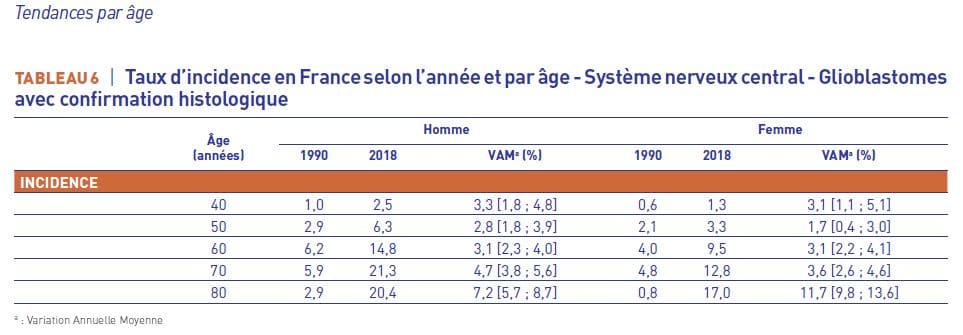
Age trends show an increase in incidence regardless of age and gender between 1990 and 2018.
According to Santé Publique France, similar observations are observed in the United States where an increase in the incidence of glioblastoma was also observed in the years 1980-1990 in connection with diagnostic progress. In addition, an Australian study reports an increasing incidence of histological confirmed glioblastoma over the period 2000-2008.
In conclusion of its analysis, Santé Publique France considers that the extrinsic factors that may play a role in increasing the incidence of glioblastoma could be:
“brain radiation therapy and possibly intense and prolonged exposure to pesticides (farmers)[14]. The latest epidemiological studies and animal experiments would support the carcinogenic role of exposure to electromagnetic fields[15]”
For Dr Annie Sasco, cancer epidemiologist, former Director of Research Unit at IARC-WHO:
“The evolution of incidence and mortality rates of central nervous system tumors as a whole and especially glioblastoma over the past 30 years is of particular concern. Of course, diagnostic behaviours have evolved and play a role, especially for older people. Nevertheless, there is a real increase, even among the youngest, for whom it is likely that diagnostic modalities have changed less than among the elderly and which may therefore be linked to environmental factors and primarily to the use of mobile or wireless phones. Informing the public should make it possible not to continue on this upward trajectory, especially among young people, with an absolute duty to protect children by not allowing them to use a cellular phone and in general by protecting them from exposure to electromagnetic fields“.
For Dr. Marc Arazi, President of Phonegate Alert:
“Over the last 2 decades, nearly 50,000 people have been affected in France by this extremely aggressive brain tumor, which has a very high mortality rate. It was also during this period that mobile telephony exploded and industrialists knowingly overexposed us to the waves of our mobile phones. This industrial and health scandal has a name, the “Phonegate”! Public authorities can no longer deny the evidence and must urgently protect the health of tens of millions of users.

