We examined one of the first published of the several systematic reviews being part of WHO’s renewed initiative to assess the evidence of associations between man-made radiofrequency electromagnetic radiation (RF-EMF) and adverse health effects in humans. The examined review addresses experimental studies of pregnancy and birth outcomes in non-human mammals. The review claims that the analyzed data did not provide conclusions certain enough to inform decisions at a regulatory level. Our objective was to assess the quality of this systematic review and evaluate the relevance of its conclusions to pregnant women and their offspring. The quality and relevance were checked on the review’s own premises: e.g., we did not question the selection of papers, nor the chosen statistical methods. While the WHO systematic review presents itself as thorough, scientific, and relevant to human health, we identified numerous issues rendering the WHO review irrelevant and severely flawed. All flaws found skew the results in support of the review’s conclusion that there is no conclusive evidence for nonthermal effects. We show that the underlying data, when relevant studies are cited correctly, support the opposite conclusion: There are clear indications of detrimental nonthermal effects from RF-EMF exposure. The many identified flaws uncover a pattern of systematic skewedness aiming for uncertainty hidden behind complex scientific rigor. The skewed methodology and low quality of this review is highly concerning, as it threatens to undermine the trustworthiness and professionalism of the WHO in the area of human health hazards from man-made RF-EMF.
Introduction
In this paper, we present a thorough analysis of the quality, validity and conclusion of the first report of a series of reviews from a renewed World Health Organization (WHO) initiative to assess the evidence of associations between (human made) radiofrequency electromagnetic radiation (RF-EMF) and adverse health effects in the general and working population. This initiative will publish several reports in “the Environmental Health Criteria (EHC) series”. The report we analyzed [1], is the first in the row, hereinafter ‘EHC2023’, published in August 2023. A companion protocol was published in 2021 [2], below just termed “the protocol”. A monograph summing up the results of these EHC reports on individual adverse effects is planned as an update of the 1993 WHO monograph on radiofrequency fields [3].
Posted inUncategorized|Comments Off on WHO to build neglect of RF-EMF exposure hazards on flawed EHC reviews? Case study demonstrates how “no hazards” conclusion is drawn from data showing hazards
A new Chinese animal study, published in November 2024 in the journal Reproductive Toxicology, highlights the harmful effects of microwaves on male reproduction. The research, conducted by a team led by Dr. Ruiyun Peng of the Beijing Institute of Radiological Medicine, provides new scientific evidence of the risks associated with wireless communication technologies.
An electromagnetic environment at risk
Microwaves are widely used in mobile communications, particularly in the 1.5 GHz (L-band) and 4.3 GHz (C-band) frequency bands. These frequencies are close to those used by 4G and 5G technologies, as the authors point out in this study:
“Yet in reality, due to the complexity of the electromagnetic environment, the human body is exposed to several microwave frequency bands. These include global mobile communication systems, widely used 4 G and 5 G cell phones, and commonly used frequency bands including L-band and C-band, [2, [3-. Therefore, it is essential to explore the biological effects of combined L- and C-band microwave exposure.”
The study shows significant impacts on reproduction
Testicular damage: testicular tissues of exposed rats showed histological and ultrastructural alterations.
Reduced sperm quality: significant decrease in sperm viability and motility.
Hormonal disturbances: reduced levels of testosterone, LH, FSH and inhibin B.
Increased oxidative stress: higher levels of lipid peroxidation and reduced activity of antioxidant enzymes.
Full Study:
Oxidative stress and energy metabolism in male reproductive damage from single and combined high-power microwave exposure at 1.5 and 4.3GHz
There is increasing evidence that exposure to weak electromagnetic fields (EMFs) generated by modern telecommunications or household appliances has physiological consequences, including reports of electromagnetic field hypersensitivity (EHS) leading to adverse health effects. Although symptoms can be serious, no underlying mechanism for EHS is known and there is no general cure or effective therapy. Here, we present the case study of a self-reported EHS patient whose symptoms include severe headaches, generalized fatigue, cardiac arrhythmia, attention and memory deficit, and generalized systemic pain within minutes of exposure to telecommunications (Wifi, cellular phones), high tension lines and electronic devices. Tests for cerebral, cardiovascular, and other physiological anomalies proved negative, as did serological tests for inflammation, allergies, infections, auto-immune conditions, and hormonal imbalance. However, further investigation revealed deficits in cellular anti-oxidants and increased radical scavenging enzymes, indicative of systemic oxidative stress. Significantly, there was a large increase in circulating antibodies for oxidized Low-Density Lipoprotein (LDLox), byproducts of oxidative stress accumulating in membranes of vascular cells. Because a known primary effect of EMF exposure is to increase the concentration of cellular oxidants, we propose that pathology in this patient may be causally related to a resulting increase in LDLox synthesis. This in turn could trigger an exaggerated auto-immune response consistent with EHS symptoms. This case report thereby provides a testable mechanistic framework for EHS pathology with therapeutic implications for this debilitating and poorly understood condition.
….
Background
The patient is a 25-year-old Caucasian male residing near the city of Compiegne, France, 195 cm, 115 kg, with marked sensitivity to exposure to electromagnetic fields and telecommunications. His symptoms include but are not limited to: sensation of pressure in the skull, sensation of acute and burning cerebral pain following a vascular trajectory; pain in the temporal region and circle of Willis; fatigue; difficulty in concentration; memory loss; lack of focus; reduced motor function; insomnia; nausea; hearing deficit and/or hyperacuity; and problems with vision. In addition, the patient experienced acute thoracic pain, dyspnea, and spasms (although without affecting oxygen saturation values); variations in arterial tension; intestinal transit problems; generalized trembling; spasms/microspasms in internal tissues (not related to muscular activity); and contractile sensations in the teeth. There is further generalized pain throughout the body, heaviness in the limbs, reduced sensitivity/feeling in the face and arms, and generalized retraction in the superficial veins (clearly visible in the hands but also occurring throughout the body).
Posted inUncategorized|Comments Off on Hypersensitivity to man-made electromagnetic fields (EHS) correlates with immune responsivity to oxidative stress: a case report
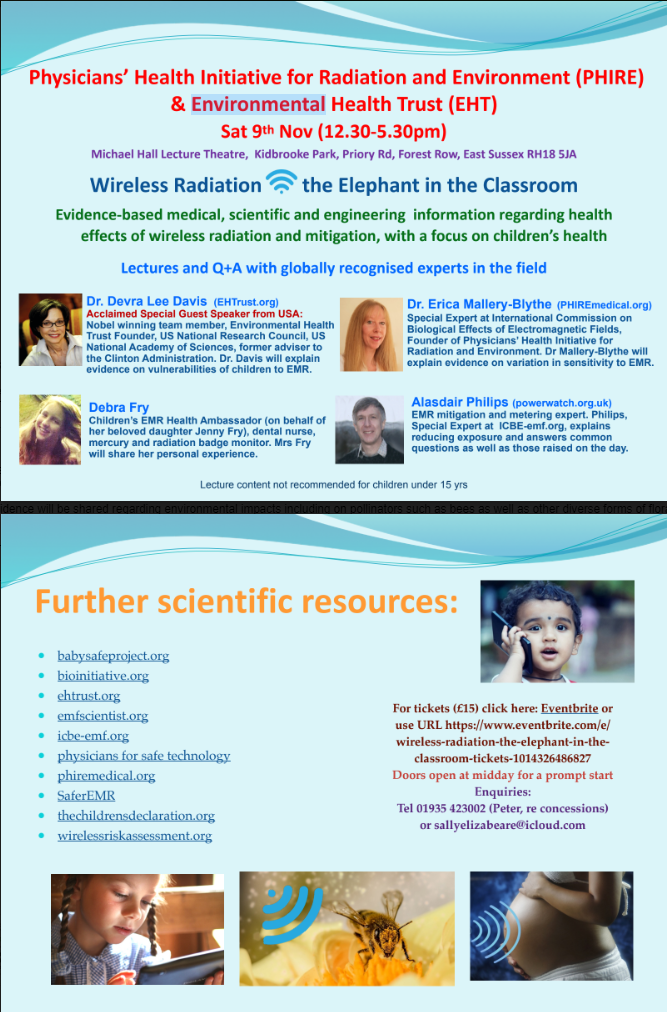
A few tickets are still available for the scientific conference on Saturday, 9th November regarding children’s health in school, Wireless Radiation: the Elephant in the Classroom. The conference is taking place in Forest Row, East Sussex.
The fully evidence-based conference will illuminate the science underpinning biological impacts of wireless radiation including neurological effects, the classification of radio frequency radiation as a Group 2B carcinogen, and specific vulnerabilities of children and adolescents. Practical, simple ways to reduce exposures at school and at home to reduce risk of negative health impacts for children and their families will be outlined.
Dr Devra Davis, epidemiologist and toxicologist, lead author on a Nobel Peace Prize-winning team, former scientific advisor to the Clinton administration, and founder of the Environmental Health Trust will be travelling from the US to explain current science published on this issue.
Dr. Erica Mallery-Blythe (Special Expert at the International Commission on Biological Effects of Electromagnetic Fields, Founder of Physicians’ Health Initiative for Radiation and Environment, Advisor for Oceania Radiofrequency Scientific Advisory Association and Honorary Member of the British Society of Ecological Medicine) will lecture on the evidence pertaining to variations in sensitivity to electromagnetic fields in humans.
In addition to the science on detrimental effects on human health, evidence will be shared regarding environmental impacts including on pollinators such as bees as well as other diverse forms of flora and fauna. The current exposure limits will be discussed and deficits in the construction of them will be explained. Two scientific papers underpinning the conference content are below.
Frequency-Dependent Antioxidant Responses in HT-1080 Human Fibrosarcoma Cells Exposed to Weak Radio Frequency Fields
Hakki Gurhan and Frank Barnes
Department of Electrical, Computer and Energy Engineering, University of Colorado Boulder, USA
Abstract
This study explores the complex relationship between radio frequency (RF) exposure and cancer cells, focusing on the HT-1080 human fibrosarcoma cell line. We investigated the modulation of reactive oxygen species (ROS) and key antioxidant enzymes, including superoxide dismutase (SOD), peroxidase, and glutathione (GSH), as well as mitochondrial superoxide levels and cell viability. Exposure to RF fields in the 2–5 MHz range at very weak intensities (20 nT) over 4 days resulted in distinct, frequency-specific cellular effects. Significant increases in SOD and GSH levels were observed at 4 and 4.5 MHz, accompanied by reduced mitochondrial superoxide levels and enhanced cell viability, suggesting improved mitochondrial function. In contrast, lower frequencies like 2.5 MHz induced oxidative stress, evidenced by GSH depletion and increased mitochondrial superoxide levels. The findings demonstrate that cancer cells exhibit frequency-specific sensitivity to RF fields even at intensities significantly below current safety standards, highlighting the need to reassess exposure limits. Additionally, our analysis of the radical pair mechanism (RPM) offers deeper insight into RF-induced cellular responses. The modulation of ROS and antioxidant enzyme activities is significant for cancer treatment and has broader implications for age-related diseases, where oxidative stress is a central factor in cellular degeneration. The findings propose that RF fields may serve as a therapeutic tool to selectively modulate oxidative stress and mitochondrial function in cancer cells, with antioxidants playing a key role in mitigating potential adverse effects.
……..
Conclusions
Our findings reveal that RF exposure at specific frequencies distinctly modulates the activities of key antioxidant enzymes, such as SOD and peroxidase, as well as GSH levels. This modulation underscores the dual role of SODs in controlling ROS damage and regulating ROS signaling, as detailed by Wang et al. [72]. By balancing ROS production and detoxification, SODs are crucial in maintaining cellular homeostasis and influencing cancer cell behavior. At 2.5 MHz, we observed significant oxidative stress, indicated by increased SOD activity and substantial GSH depletion, suggesting that hyperfine resonance effects at this frequency may amplify superoxide radical production, requiring a heightened antioxidant response. In contrast, exposure at 4 MHz led to a robust antioxidant response, characterized by elevated SOD and GSH levels and decreased H2O2. This coincided with an increase in cell viability and decreased mitochondrial superoxide, indicating enhanced mitochondrial function and an optimized balance between ROS production and antioxidant defenses in cancer cells. These frequency-dependent effects imply the involvement of hyperfine resonance interactions with mitochondrial metalloproteins, significantly impacting ROS dynamics. This modulation of ROS and apoptosis mirrors findings where RF-EMF exposure altered NADPH homeostasis and reduced superoxide levels, contributing to cell survival [73]. The potential for antioxidants to mitigate RF-induced oxidative stress underscores the need for further research into antioxidant therapies.
At an applied RF field intensity of 20 nT, our conclusions align with a broader body of evidence suggesting that low-intensity electromagnetic fields exert biological effects through non-thermal mechanisms [74]. Furthermore, concerns have been raised about the impact of RF field intensities below current safety standards, particularly for sensitive populations. While current exposure standards are primarily based on avoiding thermal effects, increasing evidence indicates that non-thermal influences of RF fields can modulate oxidative stress, ROS production, and other cellular processes [75]. Such findings call attention to the importance of re-evaluating these standards.
Investigating the therapeutic potential of combining RF exposure with antioxidant or pro-oxidant treatments could advance our understanding of how RF fields modulate cellular redox states. These findings suggest that frequency-specific RF exposure may selectively influence cancer cell oxidative stress, potentially improving the efficacy of conventional cancer therapies. Certain RF frequencies can either increase or decrease superoxide and other oxidative stress markers, thereby altering the balance between ROS production and antioxidant defenses. By increasing the susceptibility of cancer cells to oxidative damage, RF exposure could make them more vulnerable to treatments like chemotherapy or radiation, which depend on inducing oxidative stress. These mechanisms may also be relevant to age-related diseases, as oxidative stress is a shared factor in both cancer and aging, where mitochondrial dysfunction and ROS overproduction contribute to cellular decline, as noted by Hajam et al. [76]. Furthermore, the concept of mitohormesis, as described by Ristow [77], suggests that controlled ROS levels can trigger adaptive responses that protect cells from damage, thereby supporting longevity and healthy aging.
Posted inUncategorized|Comments Off on Frequency-Dependent Antioxidant Responses in HT-1080 Human Fibrosarcoma Cells Exposed to Weak Radio Frequency Fields
PRESS RELEASE FRIENDS OF THE IRISH ENVIRONMENT TUESDAY 27 AUGUST 2024: IMMEDIATE RELEASE
Three west cork telecommunications masts face high court Planning Appeals Board has ‘no expertise in telecommunications masts’
Three west cork telecommunications masts have been challenged in the High Court by the environmental charity Friends of the Irish Environment. While the organisation is ‘not opposed’ to the principle of the development of communications systems, the Reviews challenge the decisions of the Planning Appeals Board to overrule Cork County Council who found them to be in material contravention of the County Development Plan.
Challenges arise from the sale by Eircom of up to 400 ‘Eir Exchanges’.
All three challenges arise from the sale by Eircom of up to 400 ‘Eir Exchanges’ located across the State. Established by Telecom Éireann and before that its predecessor the Minister for Posts and Telegraphs, the sites were originally built for the purposes of connecting fixed line telephones to the wider network. Due to their original function, they are therefore generally located in the vicinity of residential and what might be described as ‘built up’ areas.
Under a Licence Agreement, Eircom Limited has granted to Towercom the right to install, replace, alter, develop, strengthen, augment, upgrade and renew telecommunications masts and any other associated equipment on these sites. In July 2023 the John Laing Group, a British developer and operator of infrastructure projects, bought the Irish nationwide portfolio of 409 Eir Exchanges, with over half of the sites due to be upgraded or redeveloped over the next 10 years.
However, FIE points out that, Section 4.3 of 1996 Antenna Guidelines states “Only as a last resort should free-standing masts be located within or in the immediate surrounds of smaller towns or villages.”
Further telecoms masts under challenge across Ireland include Scariff, County Clare, Aughrim, County Galway, Balbriggan, County Dublin, Kilgarvan County Kerry, Kilbrittain, County Cork and Letterfrack, Co. Galway.
Planning Appeals Board has ‘no expertise in telecommunications masts’
The High Court action also questions An Bord Pleanála’s qualifications to approve telecommunications masts after an Access to Information on the Environment request revealed that the Board ‘has no internal expertise in relation to telecommunications engineering and have not commissioned external expertise in relation to telecommunications engineering.’
Heritage and Landscape must be protected: Eyeries, Bantry, Kinsale
In the case of Eyeries, the antennae, at the edge of the village, will intrude on a protected landscape and introduce an inescapable industrial element into one of the most beautiful locations on the Beara Peninsula. In Bantry, the location is with the town itself at the edge of the Chapel Architectural Conservation Area (ACA) 10 meters from Bantry’s Old Market House, a protected structure. In both cases, the Planning Authority and the Board’s Inspector recommended refusal.
In Kinsale, the proposed location, which was opposed by four local Church bodies, is located immediately adjacent to the historic town defences, which are regarded as a national monument. Beside the Old Wall of the Town in close proximity to Protected Structures and within an Architectural Conservation Area, its protection is subject to objectives of the Cork Development Plan 2022-2028.
Project Splitting
A core ground in all three cases is the failure of the planning authorities to accept that the development of the Eir Exchange portfolio of telecoms masts across the State constitutes a ‘project’ for the purposes of the EIA Directive. This furthermore engages the concept within EU law of what is colloquially known as ‘project splitting’. FIE Director Tony Lowes said that ’the lack of EIA is very concerning given the fact that all three proposed masts were recognised by the Council as impacting on elements of the environment required to be assessed under the EIA Directive.’ Court highlights ‘serious form of allegations being made against a planning authority.’
Mr Lowes explained that ‘the Reviews of masts across Ireland were originally triggered by irregularities within the Board that led to the resignation of Paul Hyde and the reorganisation of the Board with a Report from Ms Lorna Lynch SC. However,’ Mr Lowes continued, ‘we have noted with concern a recent judgment on July 29, 2024 when the Appeals Court overturned the High Court’s previous refusal to allow a challenge to a telecoms mast in Kells, County Kilkenny. It expressed concern over An Bord Pleanála’s previous decision making in relation to telecoms masts, stating that:
‘The outcome of the appeals is something that gives cause for concern, as does the widescale overriding of recommendations from inspectors appointed by the Board. Apart from cases of actual corruption, which it must be emphasised is not even alleged let alone sought to be proven in these proceedings, it is difficult to imagine a more serious form of allegations being made against a planning authority.’
‘FIE feels that it is important that the Board apply proper planning to its decision making in relation to telecoms masts. Even if the Board feels that there is a wider societal benefit from this type of technology, the Board does not have jurisdiction under the Planning Acts to rewrite planning policy. FIE will continue to monitor decision making of the Board in this regard’, Mr. Lowes said.
ENDS
Contact: Eoin Brady of FP Logue Solicitors 353 (0)86 8524598.
(Dr. Grigoriev, one of the world’s leading experts, emailed me this message regarding the Karipidis et al. (2024) review and gave me permission to post it.)
A group of little-known scientists have claimed responsibility for all cases of cancer associated with exposure to radiofrequency electromagnetic fields. These scientists claim that possible, probable, and proven cancer from exposure to radiofrequency electromagnetic fields does not exist and never can exist. Thus, responsibility for misleading consumers, industry, and healthcare systems lies with several specific authors.
They made this conclusion based on an analysis of other people’s articles, selected using a methodology not developed by them, using analysis criteria that they also did not develop. These scientists themselves are not known for their affiliation with scientific schools studying the biomedical effects of electromagnetism, their fundamental work in the field of biological effects of electromagnetic fields and hygiene is unknown. For an unknown reason, the scientists speak on behalf of the World Health Organization, whose employees remain silent and, in principle, do not have the authority (and competence) to make such categorical conclusions. As is well known, science has no categorical judgments, even geometry from the obvious Euclidean has become non-Euclidean, the theory of relativity has become relative. We do not discover “laws of nature”, but only generalize what is known. The physical nature of the electromagnetic field has been and remains a subject of discussion, as well as human nature and the role of natural electromagnetism and electricity in it.
The discussion of the carcinogenic potential of radio frequencies has become one of the topics of the international electromagnetic project after 1996, and we have repeatedly discussed this issue with the participants of the WHO project. I have been directly involved in discussions since 1997. Every specialist involved in experimental work using several species of animals, with volunteers, with hygiene and epidemiology understands how dangerous it is to make a categorical judgment “this exists” or “this does not exist”. We all need to be very careful when meeting the statements of such authors who “know the answer” in such a complex area for research as the bioeffects of the electromagnetic field.
Dr. Oleg A. Grigoriev
Dr. Sc. (radiobiology), Ph.D.(radiobiology & hygiene of non-ionizing radiation)
Chairman, Russian National Committee for Non-Ionizing Radiation Protection
Member of the Board, Scientific Council for Radiobiology, Russian Academy of Sciences
Chairman, Non-Ionizing Radiation Section, Russian National Radiobiological Society
Chief Expert of the State Commission on Sanitary Rules (retired)
Member of the IAC WHO EMF Int Project – now WHO Non-ionizing Project (since 2004)
Member of the Advisory Group to Recommend Priorities for the IARC Monographs
during 2020–2024
See more on Joel Moskovitz’s website Electromagnetic Radiation Safety (Saferemr.com) :
Posted inUncategorized|Comments Off on Russian National Committee for Non-Ionizing Radiation Protection Chairman attacks WHO-commissioned review that claims no cellphone-cancer link
In light of the proposed ban or restricting of use of smartphones in classrooms and social media ban for children under 16, and because the government, schools, media, commentators, parents and others have made no mention of the negative health effects of radiofrequency microwave radiation from smartphones and wireless technology, here’s a reminder of just some of the many warnings, recommendations and studies regarding risks to children and young adults from mobile phones, smartphones, wifi, smart devices, for well over a decade.
Smartphones and other smart devices emit very high levels of radiation constantly, from the numerous antennas inside them sending and receiving signals back and forth to nearest wifi router, mobile phone mast and bluetooth devices, impacting not only the user but everyone nearby.
A typical smartphone has multiple antennas for wifi, for 2G, 3G and 4G (and 5G if a 5G phone), bluetooth, gps, and others. Even on standby and when not being used, smartphones and devices are emitting wireless radiation. (see video bottom of page).
Children and adolescents are especially vulnerable to exposure to electromagnetic and RF microwave wireless radiation over their lifetimes, which can contribute to adverse biological, neurological, developmental and behavioural conditions.
Update: Minister Norma Foley has proposed that a staggering €9m be spent on pouches to keep student’s phones locked in while in classes. These Yondr pouches do not block signals so unless the smartphones are on airplane mode and turned off, they will still be transmitting RF microwave radiation (see video at end), as well as able to receive messages, texts, calls etc. Students will have their smartphones with them. Yondr pouches are designed to be opened with a special magnetic base only, but they are not tamper proof.
Council of Europe Parliamentary Assembly Resolution 2011
8.3. concerning the protection of children:
8.3.1. develop within different ministries (education, environment and health) targeted information campaigns aimed at teachers, parents and children to alert them to the specific risks of early, ill-considered and prolonged use of mobiles and other devices emitting microwaves;
8.3.2. for children in general, and particularly in schools and classrooms, give preference to wired Internet connections, and strictly regulate the use of mobile phones by school children on school premises; see full text here
Electromagnetic Fields, Pulsed Radiofrequency Radiation, and Epigenetics: How Wireless Technologies May Affect Childhood Development https://pubmed.ncbi.nlm.nih.gov/28504324/
“We may not truly understand the health affects of mobile phones for many years. However, research does show that using mobile phones affects brain activity. There is general consensus that children are more vulnerable to radiation from mobile phones than adults. Therefore the sensible thing to do is to adopt a precautionary approach rather than wait to have the risks confirmed.”Dept of Health Press Release Chief Medical Officer
In 2011, an un-enacted Irish Mobile Phone Radiation Warning Bill 2011 indicated recognition of a need to introduce precautionary measures (especially for children and pregnant women). It was dropped by the Government Mobile Phone Bill 2011Oireachtas.ie
The International Declaration on the Human Rights of Children in the Digital Age
The United Nations Convention on the Rights of the Child guarantees nondiscrimination, devotion to the best interests of the child, the right to life, survival and development, and respect for the views of the child. Other international appeals recognize additional or supplemental rights of children, such as the European Union Action on the Rights of the Child, and the Reykjavik Appeal on Wireless Technology in Schools.
The existence of the legal rights of children is well recognized, but not adequately or uniformly enforced, especially when those rights conflict with powerful commercial interests. In this document we set out three fundamental legal rights of children regarding the deployment and use of technology: their right to be free from intentionally addictive devices, platforms and apps; their right to be free from harmful exposures to radiation; and their right to be free from commercial exploitation.
The legal duty to protect children and enforce these rights on their behalf is the obligation of all adults, particularly parents, legal guardians and others in positions of authority. This protection of children is a basic legal principle that we believe will increasingly be recognized as a part of international customary law that can be recognized and implemented by every country on Earth. https://www.thechildrensdeclaration.org/
This video shows the RF wireless radiation emitting from a smartphone while it is just on standby. Even on standby the levels are high.
The radiation levels will be much higher than this and continuous when the smartphone is being used for calls, internet access, streaming music, watching videos, whatsapping, messaging, etc.
Posted inUncategorized|Comments Off on SMARTPHONE BAN. Smart tech and Children. Years of warnings to protect health and well-being of children and adolescents




 Electromagnetic Sense Ireland