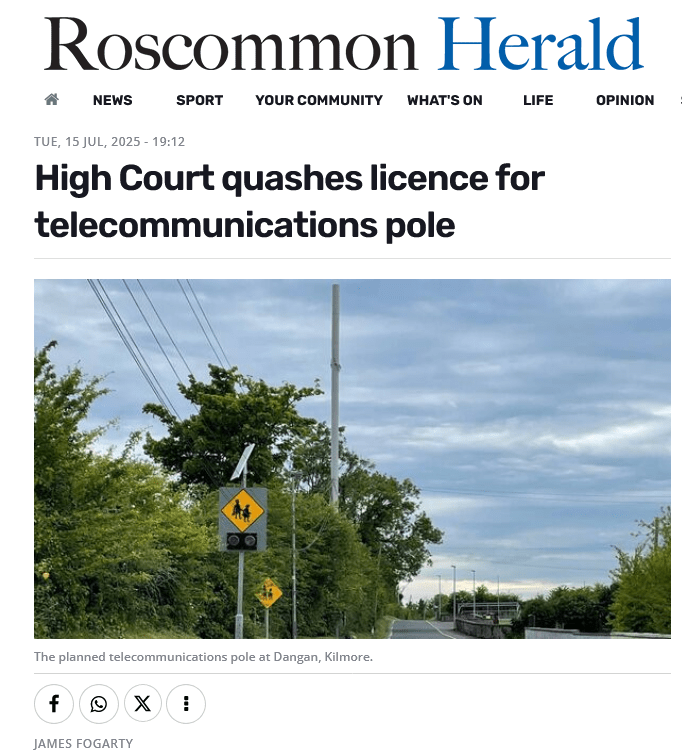
A decision granting a licence for a controversial telecommunications pole at Dangan, Kilmore has been quashed. The development is located close to a local school, community centre, and church, and was a cause of some concern among residents. Among the concerns were fears about exposure to non-ionising radiation from the pole’s antenna. The licence for the development was granted by Roscommon County Council in June 2021.
In March of 2024, An Bord Pleanála upheld the council granting Cellnex, formerly Cignal Infrastructure Limited, a Section 254 Licence for the provision of a 15m smart streetpole and operator cabinet, after an appeal was lodged in May 2023.
The inspector recommended that the licence be refused. In making its decision, ABP did not accept the inspector’s recommendation.
Subsequently, in May of last year, a judicial review was taken by solicitors FP Logue LLP on behalf of a local resident, and the High Court has now quashed the planning permission. The applicant had argued that the decision was invalid because ABP “acted irrationally and contrary to fair procedures and natural justice by failing to have any or any adequate regard to the informed opinion of its inspector”.
When contacted by the Roscommon Herald ABP said the board conceded the judicial review “on core ground 2”, that the board failed to give any/adequate reasons for discounting the recommendation of the inspector to refuse the licence. It added that the applicant for the development, Cellnex, did not seek remittal, meaning there will be no reconsideration of the licence appeal by An Bord Pleanála.
When contacted Cellnex said it has been fully compliant with planning legislation in relation to the development at Dangan “and it will remain compliant with planning legislation in relation to this development”. When asked whether the development would now be removed, it declined to make any further comment.
A Co Kilkenny couple has won a landmark decision in the Supreme Court ensuring they can challenge an An Bord Pleanála decision to allow a mobile phone mast to be built beside their property.
Peter Thomson and his wife Doreen had initially objected to the construction of the mast adjacent to their home in Kells alleging that the decision to grant permission had been affected by “bias”.
That objection was dismissed by the High Court as being made outside the time limit of eight weeks for taking a legal action, only for that decision to be overturned by the Court of Appeal.
An Bord Pleanála subsequently appealed that decision to the Supreme Court with arguments being heard from both sides in January of this year.
The latest unanimous decision by the five justices of the higher court means that the Thomsons’ objection can finally be heard in the High Court.
The couple’s case had alleged the statistical probability was zero that An Bord Pleanála’s former deputy chair Paul Hyde — one of nine board members at the time — would have been allocated 42 out of 49 mast applications by Eircom in less than two years.
Mr Hyde had approved the 15m-tall mast beside the Thomsons’ property against the advice of his own planning inspector, Philippa Joyce, in June 2021.
In May 2022, the Irish Examiner first reported Mr Hyde had overruled his own planning inspectors’ recommendations for refusal of mast applications in 86% of cases over a 20-month period up to May 2022 — roughly eight times the average for such an occurrence.
Although evidence of alleged irregularities in the decision-making of Mr Hyde became public knowledge in May 2022, the Thomsons did not take their action until November — six months later — with Peter Thomson’s submission to the court stating he had feared “an adverse costs order”.
Mr Hyde eventually resigned from An Bord Pleanála before being criminally convicted of making false or misleading declarations regarding his own assets in 2023.
In the unanimous judgement for the Supreme Court dismissing the board’s appeal, Justice Seamus Woulfe agreed with the Court of Appeal that the public interest of seeing the Hyde decisions tested in court should outweigh in importance the need for the commercial certainty provided by decisions made by the planning body being guaranteed to stand once the statute of limitations had expired.
He noted that the allegations made by the Thomsons “go far beyond the facts of one individual planning decision, and involve systemic issues about the operation of the board over a number of years and the integrity of the planning regime in this jurisdiction”.
Reacting to the decision solicitor Eoin Brady, a partner at FP Logue Solicitors who acted for the Thomsons for the case’s duration, said that it was “a welcome confirmation from the Supreme Court of the critical importance of the integrity of the planning system”.
“When there are questions over the integrity and objectivity of our national planning institutions, it results in a significant corrosion of public confidence which ultimately undermines democracy,” Mr Brady said, adding that the decision “reflects the importance of the public interest in the integrity of our planning system”.
Posted inUncategorized|Comments Off on A comprehensive mechanism of biological and health effects of anthropogenic extremely low frequency and wireless communication electromagnetic fields
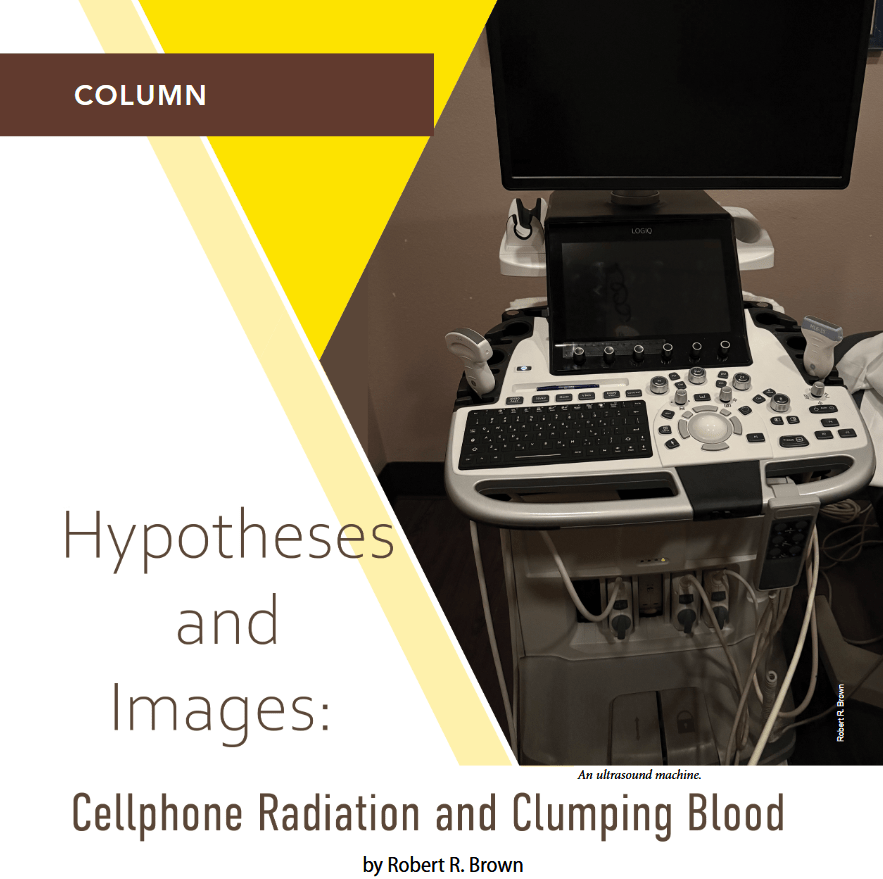
Brown, R. R. (2025). Hypotheses and Images: Cellphone Radiation and Clumping Blood. Environment: Science and Policy for Sustainable Development, 67(3), 57–60
EXCERPT
Assessing human health risks from environmental exposures remains a vexing challenge. Experiments on cell cultures (in vitro) or living animals (in vivo) are employed to predict damage to human health. In vitro tests are increasingly questioned for their relevance to human health.
Researchers have described an abnormal response in the blood termed the rouleaux phenomenon for people exposed to cellphone or Wi-Fi router radiofrequency radiation (RFR). Rouleaux is an atypical condition where red blood cells adhere to each other, yielding a clump or cluster resembling a stack of coins. Until now, the diagnosis of rouleaux by researchers has been based on an in vitro technique involving evaluation of stained blood from living animals or humans through “live blood cell analysis with dark field microscopy.” This technique is subject to two types of artifacts: misinterpretation of the sample, or because there are blood clumps from improper preparation rather than from exposure to radiofrequency radiation.
As a diagnostic radiologist with decades of experience evaluating blood flow with ultrasound, I realized ultrasound technology could diagnose red blood cell clumping from radiofrequency radiation in dynamic real time, in vivo. During ultrasonography, rouleaux formation has a well-recognized appearance, and is associated with infectious and inflammatory processes, connective-tissue diseases, some forms of cancer, and other health conditions.
A colleague and I carried out a study on a healthy volunteer, recently published in Frontiers in Cardiovascular Medicine. We showed that just 5 minutes of direct exposure to an operating cellphone in contact with the skin surface behind the knee (see Supplemental Videos Links, page 57) produced rouleaux formation in the popliteal vein.
The blood vessel in this location, the popliteal vein, is easy to see because it is large and close to the skin surface. Our subject initially had a normal-appearing vein on ultrasound, meaning there was nothing visible inside of the vessel. A normal vessel’s interior (arrows) appears black on ultrasound because there are no reflections of sound occurring from within the vessel.
Normal ultrasound appearance of the popliteal vein, arrows indicate blood vessel interior.
For a structure to create a white dot or reflection of sound, that is, an “echo” on ultrasound, it needs to be of sufficient size. The detectable size is determined when the technologist chooses a probe that emits a certain frequency or frequency range depending on how deep into the body they want to see. The lower the frequency, the more deeply the sound travels, but the probe will only detect larger things.
We used a linear 2–9 MHz transducer for the vascular ultrasounds. Frequencies between 2 and 9 MHz only detect structures larger than 154 microns.
Although rouleaux formation is usually reversible in healthy persons, meaning the blood will return to normal over time, there are reports that rouleaux may increase one’s risk for developing a larger blood clot, which could then lead to a potentially fatal pulmonary embolism or stroke.
Our findings help confirm that radiofrequency radiation emitted by a cellphone, and most likely other electronics utilizing wireless communication, creates potentially damaging physiological effects at exposure levels significantly lower than the commonly accepted safety level. Although such effects have been described by hundreds of researchers, they have been discounted by industry and regulatory agencies, who rely on determinations of specific absorption rate, SAR, for safe exposure limits. This study presents a visible manifestation of at least one phenomenon occurring within current SAR exposure levels. Regulatory reliance on SAR has led us down a dangerous path impacting human and environmental health.
Founder of the Coeurs d’EHS association (EHS Hearts)
Hello,
I’d like to inform you that, as every year,World EHS Day, subtitled “World Day of Intolerance to Electromagnetic Pollution”, will take place on June 16.
This Day, which I created on June 16, 2018, was taken up in a few European countries from its first edition and very quickly became global. A dedicated Facebook group promotes it internationally and, this year, almost 2,000 organizations and people concerned by EHS will be informed by email about the event.
Please forward this email to your contacts interested in this cause. If we ALL get involved, we’ll make this a great day!
On 27th February 2025, the Irish Times published an article titled ‘Is there a connection between mobile phones and cancer? Irish Times 27/2/25
In response to the article, Professor Tom Butler, UCC, wrote a letter to the Editor a few days later – which was been published today 20th May 2025.
The publication of the letter followed a formal complaint by Prof Butler to The Press Ombudsman that the original Irish Times article may have breached Principle 1 of the Press Council of Ireland’s Code of Practice viz. “Principle 1 − Truth and Accuracy 1.1 In reporting news and information, the press shall strive at all times for truth and accuracy.”
February 2020 – The Press Ombudsman upheld a complaint by Professor Tom Butler that The Irish Times breached Principle 1 (Truth and Accuracy) of the Code of Practice of the Press Council of Ireland. Irish Times and Tom Butler
September 2023 – Professor Tom Butler, Letter to the Irish Examiner ‘Phone Radiation’
The 5th of May 2025 saw the passing of yet another great Trojan in the campaign for safe technology – John Weigel – who died after a short illness.
John was a writer and researcher. He spent many years campaigning and sharing information and knowledge from around the world spelling out the clear scientific evidence of adverse health effects from radiofrequency microwave and EMF radiation from our technological infrastructure and smart devices, as well as the dangers of the potential corporate and political misuse of the technology.
He set up the Alliance for Irish Radiation Protection and gave talks around the country about the adverse health effects from masts, wifi, mobile phones, etc
In addition to health risks, he warned of the real threat to our privacy, security and democracy should we ‘take our eye off the ball’.
John was described by those who met him as a highly intelligent man who was warm, kind, committed, easy to approach and talk to, and challenging.
A sufferer himself, John’s support and encouragement to many others with Electromagnetic Radiation Syndrome will be especially missed, along with his sense of fun.
Scientific Experts Urge the FCC to Establish Science-Based Exposure Limits to Address Wireless Health Risks
Media Contact: communications@icbe-emf.org
Press Release April 27, 2025
Environment International has published a new systematic review, partially funded by the World Health Organization, concluding that there is high certainty of the evidence linking cell phone radiofrequency (RF) radiation to two types of cancer in animals. In response, leading scientists from the International Commission on the Biological Effects of Electromagnetic Fields (ICBE-EMF) are calling for immediate policy action to protect public health and the environment, warning that further delay could have serious consequences amid the global surge in the use of wireless communication devices.
What the Review Found
A new systematic review of 52 animal studies, “Effects of Radiofrequency Electromagnetic Field Exposure on Cancer in Laboratory Animal Studies” by Mevissen et al. (2025), concluded there is high certainty of the evidence linking RF radiation exposure to two types of tumors: gliomas in the brain and malignant schwannomas in the heart. Notably, the same types of tumors have also been observed in human studies, adding significant confidence that the associations observed in human studies are real.
The review also found moderate certainty of evidence of an increased risk of rare tumors, such as pheochromocytomas in the adrenal glands and hepatoblastomas in the liver. Additionally, some studies indicated a possible association with lymphomas, although the findings were inconsistent.
ICBE-EMF highlights that in 2011, the World Health Organization’s International Agency for Research on Cancer (IARC) classified radiofrequency radiation (RF-EMF) as a Group 2B “possible” human carcinogen, noting limited animal evidence. Since then, major animal studies — including those by the U.S. National Toxicology Program and the Ramazzini Institute — have found that RF radiation exposure causes cancer in rats.
The new WHO-funded review, concluding there is “high certainty” animal evidence of cancer causation, reinforces calls for IARC to urgently reevaluate the cancer classification of RF radiation.
Given this high level of certainty, government policymakers worldwide should immediately move to revise their RF radiation exposure limits to protect public health and the environment.
Statements by Experts of the International Commission on the Biological Effects of Electromagnetic Fields
“The evidence is now clear —cell phone radiation can cause cancer in animals in concordance with the tumor types identified in human studies of mobile phone users. As animal studies are essential for predicting cancer risk in humans, governments should develop science-based safety standards to protect human health. The conclusion of the study commissioned by the WHO shows that the long-standing assumption current government limits are based on — that cell phone RF radiation can only cause harm through tissue heating — is wrong” stated Ron Melnick, PhD, Chair of the ICBE-EMF and former senior toxicologist and Director of Special Programs at the National Toxicology Program and the National Institute of Environmental Health Sciences (NIEHS).
“The preponderance of the research published since 1996 finds adverse biologic and health effects from long-term exposure to low levels of modulated or pulsed wireless RF radiation. Given the widespread global usage of wireless among users of all ages, even a very small increase in the incidence of disease will have broad implications for public health,” stated said Joel Moskowitz, PhD, Director of the Center for Family and Community Health at the School of Public Health, University of California, Berkeley, also an ICBE-EMF member.
“To protect public health and the environment, exposure to cell phone and wireless radiation must be significantly reduced,” said Elizabeth Kelley, Managing Director of ICBE-EMF. She referenced the EMF Scientist Appeal now signed by 267 scientists from 45 nations. “Hundreds of scientists worldwide agree that current exposure limits are outdated and do not adequately protect against health risks.”
ICBE-EMF emphasizes that governments must act immediately to strengthen regulatory limits on wireless radiation to protect public health. Wildlife exposures must be mitigated. Current exposure standards, based on outdated assumptions, do not reflect the scientific evidence linking RF radiation to cancer and other health effects.
ICBE-EMF also highlights practical steps the public can take to reduce exposure — such as using speakerphone or wired headsets, keeping devices away from the body, and limiting wireless use among children — but stresses that personal actions are not a substitute for government-enforced safety standards. Stronger, science-based regulations are urgently needed to address the widespread and increasing exposure to wireless radiation.
About the ICBE-EMF
ICBE-EMF is an international consortium of scientists, doctors and researchers with expertise and peer-reviewed publications on the biological and health effects of electromagnetic fields including wireless RF radiation. Wireless devices such as cell phones, cordless phones, Wi-Fi and cell towers emit radiofrequency (RF) radiation.
ICBE-EMF recently published major scientific papers concluding that current government safety limits for wireless radiation are not protective of public health and highlighting engineering solutions that could dramatically reduce radiation emissions from cell phones.
The Commission is committed to upholding the highest standards of scientific research and makes science-based recommendations to ensure the protection of the public and environment. icbe-emf.org
Posted inUncategorized|Comments Off on PRESS RELEASE: NEW WHO-FUNDED STUDY REPORTS HIGH CERTAINTY OF THE EVIDENCE LINKING CELL PHONE RADIATION TO CANCER IN ANIMALS
A new study published in the Fortune Journal of Health Sciences by Dr. Lennart Hardell and researcher Michael Carlberg reported an association between prostate cancer and exposure to the radiofrequency (RF) radiation emitted by cell phones.
Exposure to radiofrequency (RF) radiation in the frequency range 30 kHz–300 GHz was in 2011 evaluated by the International Agency for Research on Cancer (IARC) at the World Health Organization (WHO) to be a ‘possible’ human carcinogen, Group 2B. This was based on epidemiological results on increased risk for glioma and acoustic neuroma. Results on other cancer types are sparse. An increased incidence in male rats of proliferative lesions in the prostate gland induced by RF radiation was found in the US NTP study. Thus, it was pertinent to study an association with prostate cancer in human studies. We analyzed data in two of our previous studies, one on brain tumors (only deceased subjects; those who died from prostate cancer were defined as cases) and another on prostate cancer (living subjects) that included similar questions on use of mobile phones or cordless phones. The pooled analysis gave for mobile phone use OR = 1.8, 95 % CI = 1.01-3.1, increasing in the >10 year latency group to OR = 2.8, 95 % CI = 1.5-5.3. Also, use of the cordless phone gave increased risk, although not statistically significant. Dose-response analysis gave highest risk for >2,000 h use of the mobile phone with OR = 2.4, 95 % CI = 1.2-5.1. The cordless phone yielded highest risk in the group 1001-2000 h with OR = 2.3, 95 % CI = 1.01-5.4. Lower OR was seen for use > 2,000 h but based on low numbers. Higher risk was seen in cases with more aggressive cancer based on Gleason score, PSA, and high risk profile, and among subjects with heredity for prostate cancer.
US The National Institutes of Health (NIH) refuses to reveal nearly 2,500 pages of records related to the National Toxicology Program’s (NTP) decision to shut down its research on how wireless radiation affects human health, according to an investigation by The Defender.







 Electromagnetic Sense Ireland