HISTORIC VICTORY IN US – Federal Court Orders FCC to Explain Why It Ignored Scientific Evidence Showing Harm from Wireless Radiation

Source Article : EHTrust                                                13th August 2021

United States Court of Appeals for the District of Columbia Circuit judges in favor of environmental health groups and petitioners; finds FCC violated the Administrative Procedure Act and failed to respond to comments on environmental harm.

Today, the United States Court of Appeals for the District of Columbia Circuit ruled in the historic case EHT et al. v. the FCC that the December 2019 decision by the Federal Communications Commission (FCC) to retain its 1996 safety limits for human exposure to wireless radiation was “arbitrary and capricious.”  

The court held that the FCC failed to respond to “record evidence that exposure to RF radiation at levels below the Commission’s current limits may cause negative health effects unrelated to cancer.” Further, the agency demonstrated “a complete failure to respond to comments concerning environmental harm caused by RF radiation.” 

“We are delighted that the court upheld the rule of law and found that the FCC must provide a reasoned record of review for the thousands of pages of scientific evidence submitted by Environmental Health Trust and many other expert authorities in this precedent setting case. No agency is above the law. The American people are well served,” said Dr. Devra Davis, president of Environmental Health Trust. 

Edward B. Myers, attorney for Environmental Health Trust, the lead petitioner in the case, EHT et al. v. the FCC stated, “The court granted the petitions for review because, contrary to the requirements of the Administrative Procedure Act (APA), the commission failed to provide a reasoned explanation for its assertion that its guidelines adequately protect against the harmful effects of exposure to radiofrequency radiation.”

“I am very pleased to see that the U.S. Court of Appeals for the District of Columbia Circuit has ruled that the FCC ignored decades of studies about the potential health harms of cell phone radiation and must adequately review this material before making a decision about new regulations of cell phones,” said Dr. Jerome Paulson, former American Academy of Pediatrics Environmental Health Council Chair and now Professor Emeritus of Pediatrics and Environmental and Occupational Health at George Washington University School of Medicine and Health Sciences and Milken Institute School of Public Health. “It is very important that the court ruled that the FCC must address the impacts of radiofrequency radiation on the health of children amassed since 1996.” The American Academy of Pediatrics’ submission to the FCC called for a review of safety limits to protect children and pregnant women. 

In overturning the FCC determination for its lack of reasoned decision making, the court wrote that the commission cannot rely on agencies like the Food and Drug Administration (FDA) if the FDA’s conclusions are provided without explanation.  

“While imitation may be the highest form of flattery, it does not meet even the low threshold of reasoned analysis required by the APA under the deferential standard of review that governs here. One agency’s unexplained adoption of an unreasoned analysis just compounds rather than vitiates the analytical void. Said another way, two wrongs do not make a right,” the court wrote. 

The court further noted that the FCC failed to respond to approximately 200 comments on the record by people who experienced illness or injury from electromagnetic radiation sickness. 

The court ordered the commission to “(i) provide a reasoned explanation for its decision to retain its testing procedures for determining whether cell phones and other portable electronic devices comply with its guidelines, (ii) address the impacts of RF radiation on children, the health implications of long-term exposure to RF radiation, the ubiquity of wireless devices, and other technological developments that have occurred since the Commission last updated its guidelines, and (iii) address the impacts of RF radiation on the environment.”

Download August 13, 2021 United States Court of Appeals, District of Columbia Circuit ENVIRONMENTAL HEALTH TRUST, ET AL., PETITIONERS v. FEDERAL COMMUNICATIONS COMMISSION AND UNITED STATES OF AMERICA

The landmark case centers around the FCC’s decision not to update its 1996 exposure limits for wireless radiation from cell phones, cell towers, and wireless devices. Environmental Health Trust experts have long argued that the FCC’s outdated limits place Americans everywhere at risk, especially in the era of 5G.  


READ MORE:

EHT-Victorious-in-Federal-Court-Case-Against-the-FCC-on-Wireless-Radiation-Limits

Part I: Why We Need Stronger Cell Phone Radiation Regulations–Key Testimony Submitted to the FCC     Joel M. Moskowitz, Ph.D.

https://www.electricalpollution.com


Posted in Uncategorized | Comments Off on HISTORIC VICTORY IN US – Federal Court Orders FCC to Explain Why It Ignored Scientific Evidence Showing Harm from Wireless Radiation

Human Rights Scandal in Switzerland / Schweiz and Worldwide – by Réza Ganjavi, MBA

Reza Ganjavi, MBA

MBA, BSCS, BA Phil, magna cum laude, Phi Kappa Phi, Alpha Gamma Sigma

Philosopher, Musician, Scientist, Activist, Author, IT Expert, Management Consultant


Posted in Uncategorized | Comments Off on Human Rights Scandal in Switzerland / Schweiz and Worldwide – by Réza Ganjavi, MBA

EUROPEAN PARLIAMENTARY RESEARCH – HEALTH IMPACT OF 5G – CARCINOGENIC AND REPRODUCTIVE/DEVELOPMENT HAZARDS

This study has been written by Dr Fiorella Belpoggi, BSc, PhD, International Academy of Toxicologic Pathology Fellow (IATPF), Ramazzini Institute, Bologna (Italy), at the request of the Panel for the Future of Science and Technology (STOA) and managed by the Scientific Foresight Unit, within the Directorate-General for Parliamentary Research Services (EPRS) of the Secretariat of the European Parliament.

Click to access EPRS_STU(2021)690012_EN.pdf

https://www.europarl.europa.eu/RegData/etudes/STUD/2021/690012/EPRS_STU(2021)690012_EN.pdf

Posted in Uncategorized | Comments Off on EUROPEAN PARLIAMENTARY RESEARCH – HEALTH IMPACT OF 5G – CARCINOGENIC AND REPRODUCTIVE/DEVELOPMENT HAZARDS

ECO-EYE RTE 1 – DISINFORMATION ON MAN-MADE RADIATION RISKS

On 28th January 2021, RTE 1 broadcast a programme by ECO Eye on the dangers of radiation.  The show mainly dealt with Radon gas but there was also mention of EMF radiation and 5G. 

The presenter, Dr Kambamettu, a psychologist  and Dr McMahon from the EPA, were quick to dismiss and “debunk” some “myths” about health effects from wireless radiation, and state  ‘that the man-made radiation that everyone is afraid of, is not worth being worried about’.

Following this programme in January, letters were sent to Dr Kambamettu, the EPA, Earth Horizons and Duncan Stewart, the producers of the programme.

Letter to Eco-Eye episode “Radiation: The Silent Killer”  RTE1  es-ireland.com/2021/02/22/ (copies sent to production company Earth Horizons and Duncan Stewart)

Email sent to  Dr Kambamettu re Eco-Eye episode – David Sullivan

No responses were received.

The programme was repeated on Monday 19th July 2021.  Comments, with links to peer-reviewed scientific studies etc. were made on Eco-Eye’s facebook page but quickly disappeared. Comments made on their You Tube page also disappeared.

https://www.facebook.com/ecoeye15

Posted in Uncategorized | Comments Off on ECO-EYE RTE 1 – DISINFORMATION ON MAN-MADE RADIATION RISKS

Vienna Is the New Havana Syndrome Hot Spot

Source Article : The New Yorker

Roughly two dozen possible new cases have been reported by U.S. spies and diplomats in the Austrian capital, more than in any other city except Havana itself.

Since Joe Biden took office, about two dozen U.S. intelligence officers, diplomats, and other government officials in Vienna have reported experiencing mysterious afflictions similar to the Havana Syndrome. U.S. officials say the number of possible new cases in the Austrian capital—long a nexus of U.S. and Russian espionage—is now greater than the number reported by officials in any city except for Havana itself, where the first cases were reported.

The exact cause of the ailments in Vienna, which U.S. government agencies formally refer to as “anomalous health incidents” or “unexplained health incidents,” remains unknown, but in response to the surge the C.I.A., the State Department, and other agencies are redoubling their efforts to determine the cause, and to identify the culprit or culprits. A C.I.A. spokesperson said that the agency’s director, William Burns, was “personally engaged with personnel affected by anomalous health incidents and is highly committed to their care and to determining the cause of these incidents.” Privately, Burns has called the maladies “attacks” rather than incidents. A State Department spokesman said, “In coordination with our partners across the U.S. government, we are vigorously investigating reports of possible unexplained health incidents among the U.S. Embassy Vienna community.”

The Havana Syndrome derives its name from the Cuban capital, where C.I.A. officers and State Department employees first reported experiencing strange sensations of sound and pressure in their heads in 2016 and 2017. Some of the patients said the sensations seemed to follow them around their homes, apartments, and hotel rooms in the Cuban capital. Some of the patients described feeling as though they were standing in an invisible beam of energy. Many of them suffered debilitating symptoms, from headaches and vertigo to vision problems. Specialists at the University of Pennsylvania’s Center for Brain Injury and Repair used advanced MRIs to study the brains of forty of the original patients from Havana. They found no signs of physical impact to the patients’ skulls—it was as if they had “a concussion without a concussion,” one specialist told me—and the team detected signs of damage to their brains.

Senior officials in the Trump and Biden Administrations suspect that the Russians are responsible for the syndrome. Their working hypothesis is that operatives working for the G.R.U., the Russian military-intelligence service, have been aiming microwave-radiation devices at U.S. officials, possibly to steal data from their computers or smartphones, which inflicted serious harm on the people they targeted. But American intelligence analysts and operatives have so far been unable to find concrete evidence that would allow them to declare that either microwave radiation or the Russians were to blame.

The F.B.I. launched its own investigation into the events in Havana but agents have so far found no dispositive evidence of any attacks. Profilers with the Bureau’s Behavioral Analysis Unit conducted their own assessments of the Havana patients without interviewing them directly.The unit concluded that they were suffering from a mass psychogenic illness, a condition in which a group of people, often thinking that they have been exposed to something dangerous, begin to feel sick at the same time. The patients themselves—as well as their University of Pennsylvania doctors and many government officials who have met with them—were infuriated by the Behavioral Analysis Unit’s assessment, which was based on transcripts of previous interviews that the F.B.I. had done with some of the patients, and on “patient histories” compiled by the individuals’ doctors, who had already ruled out mass psychogenic illness as the cause. According to these doctors, many of the patients didn’t know that the other people were sick, and their bodies could not have feigned some of the physical symptoms that they were exhibiting. A U.S. official told me that the F.B.I. is now reassessing its mass-psychogenic-illness conclusion in light of the newly reported cases.

After the events in Cuba, a handful of potentially related cases involving C.I.A. and State Department personnel emerged in other countries; one of them involved a C.I.A. officer who, in 2017, woke up in a Moscow hotel room with severe vertigo. In 2018, American diplomats at the consulate in Guangzhou, China, reported more possible cases, though State Department officials have never disclosed how many of those patients were confirmed to have the syndrome. In early June, 2019, two White House staffers reported Havana Syndrome-like episodes in a hotel room in London during a state visit by then President Donald Trump. One of those victims subsequently reported an incident outside her home in Virginia. By mid-2020, at the direction of Trump’s National Security Council, government agencies started to report possible syndrome cases to a special unit within the Office of the Director of National Intelligence. In the months that followed, dozens of American officials, including members of the U.S. military, came forward to report similar episodes. Among them were at least two other White House staff members who said they were afflicted while crossing the Ellipse, near the White House. Other cases were reported in Colombia, Kyrgyzstan, and Uzbekistan, among other places.

On December 3, 2020, Gina Haspel, Trump’s C.I.A. director, whom White House national-security officials described as “skeptical” that the syndrome was real, sent a message to C.I.A. officers worldwide, encouraging them to report any unexplained health incidents that might be Havana Syndrome. The State Department and other government agencies sent similar messages to their employees. When Trump left office, there were no reported cases at the U.S. Embassy in Vienna, whose C.I.A. station is one of the largest in the world.

Vienna has long been a den of spies. The city is home to many large U.N. agencies, the Organization of the Petroleum Exporting Countries, and the International Atomic Energy Agency, among other international bodies that employ officials from around the world who have access to information of interest to U.S. and foreign intelligence services. In addition to significant numbers of American, British, Chinese, French, and Russian spies, the Iranians, the Syrians, and the North Koreans, among others, are believed to have operatives on the ground in Vienna.

Traditionally, Austria’s domestic-security services have turned a blind eye to foreign-intelligence operations on Austrian soil as long as those operations don’t threaten Austrian interests. “If you spy against other governments in Vienna, you’re left alone. That’s what everybody likes,” Siegfried Beer, the founder of the Austrian Center for Intelligence, Propaganda, and Security Studies, located on the campus of the University of Graz, said. “This is why, when spies are detected, they disappear quickly.”

U.S. intelligence officers, especially those with families, have long sought out assignments in Vienna because the city is seen as a safe, comfortable, and interesting place to live and work. “Our job is to try to get access to people and recruit them,” John Sipher, who retired from the C.I.A. in 2014 after a twenty-eight-year career in the National Clandestine Service, which included serving in Moscow and running the C.I.A.’s Russia operations, said. “Vienna is perfect. Everyone is there. It’s good living and it’s good hunting—and you don’t have to worry too much about getting caught.”

As famously depicted in the Graham Greene classic “The Third Man,” Austria was occupied by the Soviets, the Americans, the British, and the French after the Second World War. When the occupation ended, in 1955, the Austrian Parliament declared the country’s neutrality, committing to neither being in the U.S. nor Soviet camp. Their hope was to be a bridge between East and West.

When the Cold War ended, Austrian neutrality remained formally in place. At times, Vienna’s insistence on staying neutral, even in the face of blatant acts of aggression by Russian President Vladimir Putin and his intelligence services, became a source of frustration in Washington. One of those moments came in early 2018, when Trump’s national-security team tried to persuade the Austrians to join the British and other Europeans in expelling Russian spies to protest the G.R.U.’s attempted assassination in Britain of Sergei Skripal, a former Russian military-intelligence officer who had been a double agent for the U.K.’s intelligence services. “Our point was, ‘Look, they’re using your territory as a proving ground,’ ” a former Trump Administration official told me. “And they said, ‘This isn’t our fight. We’ve never had problems like this. They’re actually kind of nice to us.’ ”

Later that same year, Putin attended the wedding of Karin Kneissl, who at the time was Austria’s Foreign Minister. The two were seen embracing and dancing together at the event. White House officials were “gobsmacked” by the images, which undercut U.S. and European Union foreign policy. “The Russians value Austria. They have always thought that they had a special relationship,” a former U.S. diplomat told me. European officials told their American counterparts that they believed Putin himself had a vacation home on a lake somewhere in Austria.

One of the Trump Administration’s foreign-policy objectives was to pull Central and Eastern European states, including Austria, closer to the United States. The former U.S. Ambassador to Austria, Trevor Traina, told me that his message to the Austrian leadership was, “Despite your formal neutrality, you guys are with the West. We’re not just some casual friends. We’re allies.” Traina and his allies in Washington arranged a flurry of high-level meetings between Austrian and American leaders—“the most in history,” Traina explained. The outreach effort even got its own German word—Verbundenheit—which translates as “new closeness” or “connectedness.”

In support of Traina’s Verbundenheit campaign, Trump invited the conservative Austrian Chancellor, Sebastian Kurz, who is known in Europe for his hard-line stance against refugees, to meet with him at the White House. Some members of Trump’s National Security Council staff opposed the move and argued, “The Austrians were unhelpful on Russia,” according to the former Trump Administration official. Traina and his allies insisted that bringing the Chancellor into the Oval Office would improve bilateral relations and further isolate Russia. Asked how the Russians felt about the Verbundenheit campaign, the former U.S. diplomat told me, “I think they hated it.”

In September, 2019, three weeks before a snap Austrian election, Kurz’s conservative People’s Party disclosed that its computer networks had been hacked. Kurz said the goal of the hackers was “removing, inserting, manipulating and falsifying data” and to “damage us at the election.” He added, “This is not just an attack on the People’s Party but also an attack on the democratic system.” Then, in January, 2020, Austria’s Foreign Ministry was targeted by a cyberattack, which officials blamed on a state actor that they did not name. The former Trump Administration official said, of the cyber intrusions, “These were shots across Austria’s bow by the Russians. The Austrians were waking up.”

Later that year, the Austrians took what U.S. officials saw as an extraordinary step: the Austrian Foreign Ministry expelled a Russian diplomat who reportedly had been engaged for years in economic espionage at a technology firm. The Russian Embassy said it was “appalled by the unfounded decision of the Austrian authorities, which is damaging to constructive Russian-Austrian relations.” Russia’s Foreign Ministry retaliated in kind by declaring an Austrian diplomat persona non grata.

Senior American diplomats and spies in Vienna were on the lookout for Havana Syndrome. The Embassy in Vienna was better prepared for the ailment than most—it has its own relatively well-equipped health clinic. The U.S. Embassy is well guarded, with the street in front of it closed off on both ends to prevent vehicles from parking nearby. Pedestrians who try to take pictures of the building are often stopped and questioned by security guards, who patrol the area. Employees don’t live in the Embassy compound—they rent houses and apartments all around the city, where, presumably, they have far less security.

Burns, the C.I.A. director, who had twice served in Moscow as a State Department diplomat, believed that the agency had failed to direct enough intelligence resources to the syndrome investigation under Trump. He assembled a new “targeting team” of senior analysts and operators to try to answer two questions as quickly as possible: What is causing Havana Syndrome, and who is responsible? Burns’s new targeting team has not yet uncovered new intelligence that would allow the C.I.A. to assess with confidence the cause of the syndrome or to identify who is responsible, a process that U.S. intelligence agencies call “attribution.” “The analytic line has not changed in the intelligence community in terms of cause and possible attribution,” a senior Biden Administration official told me. “But we are intensively trying to determine the cause, intent, and the role of any foreign actor.”

The number of possible syndrome cases around the world fluctuates frequently as new suspected cases are added to the list while other cases, deemed by doctors to be unrelated ailments, are removed from the list. As of late May, more than a hundred and thirty possible cases had been reported around the world. The C.I.A. accounted for some fifty of those cases. The rest were mostly U.S. military and State Department personnel and their family members. A senior national-security official recently told me, of the latest case count, “The only thing we can say definitively on the number is that we don’t know the exact number.”

The first possible syndrome case in Vienna was reported a couple of months after Biden’s Inauguration. That case and subsequent ones were reported to officials in Washington soon after they occurred. But the Biden Administration decided not to announce the Vienna outbreak—officials were concerned that any public disclosure about the cases would hamper ongoing U.S. intelligence and law-enforcement investigations, which are still under way in Vienna. The Austrian Embassy in Washington declined to comment on the cluster of cases.

Many American officials, who suspect that Russian operatives and technology were responsible for the syndrome, believe that among Moscow’s goals in Cuba was to see whether they could force the U.S. to scale back its presence on the island. If so, then Moscow’s mission was accomplished. The C.I.A. station in Havana was shuttered by the agency’s then director, Mike Pompeo, and the U.S. diplomatic presence was curtailed dramatically by then Secretary of State Rex Tillerson.

It is unclear what impact, if any, the new cases have had on U.S. diplomatic and intelligence activities in Vienna. If the Russians are, in fact, to blame, as many top Biden Administration officials believe, their goal remains unknown. They may have hoped that the incidents in Vienna would force U.S. diplomats and spies to leave the city—there’s no indication that the Embassy or the station have been downsized. They may also have been trying to hamper American efforts to close ranks with the Austrians. The senior Biden Administration official told me, “We have not determined intent or motive. We do not have a view on that yet.”   https://www.newyorker.com/news/news-desk/vienna-is-the-new-havana-syndrome-hotspot

More about ‘Havana Syndrome’ which is Microwave Sickness HERE
Posted in Uncategorized | Comments Off on Vienna Is the New Havana Syndrome Hot Spot

The Critical Importance of Molecular Biomarkers and Imaging in the Study of Electrohypersensitivity. A Scientific Consensus International Report

Source Article : https://www.mdpi.com/1422-0067/22/14/7321

Abstract:

Clinical research aiming at objectively identifying and characterizing diseases via clinical observations and biological and radiological findings is a critical initial research step when establishing objective diagnostic criteria and treatments.

Failure to first define such diagnostic criteria may lead research on pathogenesis and etiology to serious confounding biases and erroneous medical interpretations.

This is particularly the case for electrohypersensitivity (EHS) and more particularly for the so-called “provocation tests”, which do not investigate the causal origin of EHS but rather the EHS-associated particular environmental intolerance state with hypersensitivity to man-made electromagnetic fields (EMF).

However, because those tests depend on multiple EMF-associated physical and biological parameters and have been conducted in patients without having first defined EHS objectively and/or endpoints adequately, they cannot presently be considered to be valid pathogenesis research methodologies.

Consequently, the negative results obtained by these tests do not preclude a role of EMF exposure as a symptomatic trigger in EHS patients. Moreover, there is no proof that EHS symptoms or EHS itself are caused by psychosomatic or nocebo effects.

This international consensus report pleads for the acknowledgement of EHS as a distinct neuropathological disorder and for its inclusion in the WHO International Classification of Diseases.

Read the entire study (open access) HERE and PDF

Posted in Uncategorized | Comments Off on The Critical Importance of Molecular Biomarkers and Imaging in the Study of Electrohypersensitivity. A Scientific Consensus International Report

Electric Car – $10 Million Nissan LEAF Electromagnetic Radiation Injury Lawsuit Filed in Georgia

— A Nissan LEAF electromagnetic radiation lawsuit has been filed by a Georgia man who sued the automaker “for permanently damaging his health and for destroying his family and career, not to exceed $10 million.”

The 2015 Nissan LEAF customer who filed the lawsuit alleges the car caused him serious health problems from prolonged driving while sitting on a giant battery that allegedly emits large amounts of low-frequency electromagnetic field (EMF) radiation.

The plaintiff claims the LEAF radiation is “way above” safe levels of 2 mG (milligauss) or less.

According to the radiation lawsuit, the 2015 Nissan LEAF EMF measurements are as follows:

  • Driver’s floor — up to 9.2 mG, Top of the seat — up to 5.3 mG
  • Passenger floor — up to 13.1 mG, Top of the seat — up to 4.9 mG
  • Back row floor — up to 31.3 mG, Top of the seat — up to 4.5 mG
  • Back row/top of the elevated floor panel at the center of the vehicle — up to 12.6 mG

The plaintiff says he was active and healthy prior to January 2017 but started to suffer from uncontrolled eye dilation, chest palpitations, memory loss and had difficulty concentrating. This allegedly quickly led to “sporadic hallucinations.”

“Towards the end of January 2017, the plaintiff had a difficult time to distinguish what was real and what was not, and as a result was terminated from his job. On January 25th, the Plaintiff was hospitalized with inability to hear and speak. Going forward, the Plaintiff kept suffering physical and mental symptoms and his marriage fell apart as his wife filed for divorce on April 15th, 2017.” — Nissan LEAF radiation lawsuit

The plaintiff says he was unable to work because the physical symptoms worsened if he used a computer continuously for more than 2 hours. The plaintiff further alleges it took him several years to “get his life in sort-of order where he can function in a society.”

After he was hospitalized in January 2017, his physical symptoms worsened when he drove the Nissan LEAF and “he suffered chest palpitations, facial tingling combined with pressures on his checks that felt like the cheeks were about to collapse into his face and breathing difficulties.”

According to the radiation lawsuit, the plaintiff has suffered multiple health setbacks and currently suffers from chest pains and heart palpitations, low energy, insomnia, ringing in the ears and facial tingling. In addition, the plaintiff alleges he easily gets lost in his thoughts and loses a perception of time.

The 2015 Nissan LEAF has allegedly destroyed his family and his career because he wasn’t properly shielded from EMF radiation.

In addition to seeking up to $10 million, the plaintiff says Nissan should pay up to $990 million for gross negligence.

The plaintiff says this will allow him to “start a non-profit, public awareness entity to educate people around the world about the dangers of long-term exposure to low frequency EMF radiation emitted by many unshielded electronic devices such as electric cars, cell phones, microwaves, high voltage powerlines … etc.”

The Nissan LEAF electromagnetic radiation lawsuit was filed in the U.S. District Court for the Northern District of Georgia: Josef Tater, v. Nissan North America, Inchttps://www.pacermonitor.com/public/case/40930098/Tater_v_Nissan_North_America_Inc

More Information from Environmental Health Trust

Posted in Uncategorized | Comments Off on Electric Car – $10 Million Nissan LEAF Electromagnetic Radiation Injury Lawsuit Filed in Georgia

Exposure to extremely low-frequency magnetic fields and childhood cancer: A systematic review and meta-analysis

SEE FULL STUDY HERE 10.1371/journal.pone.0251628  Published online 2021 May 14

GyeongAe Seomun Juneyoung Lee Jinkyung Park

Abstract

Background

Extremely low frequency magnetic fields (ELF-MFs) are classified as a possible carcinogenic factor (Group 2B). This study assessed the association between ELF-MFs and childhood cancer through a systematic review and meta-analysis.

Methods

Three databases were searched in January 2020. We conducted a meta-analysis for the association between the ELF-MFs exposure level and childhood cancer.

Results

A total of 33 studies were identified. Thirty studies with 186,223 participants were included in the meta-analysis. Children exposed to 0.2-, 0.3-, and 0.4-μT ELF-MFs had a 1.26 (95% confidence interval [CI] 1.06–1.49), 1.22 (95% CI 0.93–1.61), and 1.72 (95% CI 1.25–2.35) times higher odds of childhood leukemia. In childhood brain tumors, children exposed to 0.2-μT had a 0.95 (95% CI 0.59–1.56) times higher odds, and those exposed to 0.4-μT ELF-MFs had a 1.25 (95% CI 0.93–1.61). Children exposed to 0.2- and 0.4-μT ELF-MFs had a 1.10 (95% CI 0.70–1.75) and 2.01 (95% CI 0.89–4.52) times higher odds of any childhood cancers.

Conclusions

In this large pooled analysis of more than 36,000 children diagnosed with childhood leukemia, statistically significant associations were observed between exposure to ELF-MF and childhood leukemia. Furthermore, the intensity of the association between exposure to ELF-MFs and childhood leukemia was high, as indicated by the dose–response effect.

The risk of ELF-MFs, which have been classified as a possibly carcinogenic (Group 2B) factor based on limited evidence in humans, can be ascertained through precise evidence from the integrated results of this study.

https://journals.plos.org/plosone/article?id=10.1371/journal.pone.0251628

Posted in Uncategorized | Comments Off on Exposure to extremely low-frequency magnetic fields and childhood cancer: A systematic review and meta-analysis

Documentary : An Invisible Threat: The Possible Link Between Microwave Technology and Health 2014

An Invisible Threat: The Possible Link Between Microwave Technology and Health | ENDEVR Documentary

We cannot see the waves, we cannot hear them, we cannot touch them, but they are all around us, invading the air, irradiating our body and the environment. An Invisible Threat looks at the relationship between microwave technology and health, investigating the conflicts of interest among industry representatives, politicians, scientists and consumers that leave us unprotected to the effects of radiation. Wireless networks irradiate microwaves indiscriminately across cities, villages and the countryside of all developed countries. This increasing exposure disturbs the biological processes that are essential for the healthy growth of human beings, animals and plants – it especially affects children and teenagers. Our investigation delves into three groups: the telecommunications industry (mobile telephone companies, MMF); official organisations (WHO, IARC, ICNIRP) and official scientific reports (BioInitiative, Interphone, CEFALO).
(Made in 2014)

Posted in Uncategorized | Comments Off on Documentary : An Invisible Threat: The Possible Link Between Microwave Technology and Health 2014

Study – Electromagnetic Field Exposure in Kindergarten Children: Responsive Health Risk Concern

05 July 2021 |

Source Article : https://doi.org/10.3389/fped.2021.694407

Shiva Raj Acharya1*, Yong Chul Shin2, Deog Hwan Moon1 and Sandip Pahari3

  • 1Graduate School of Public Health, Busan Medical Campus, Inje University, Busan, South Korea
  • 2Department of Occupational Health and Safety, Inje University, Busan, South Korea
  • 3Department of Public Health, Pokhara University, Pokhara, Nepal

Long-term exposure to physical agents can be detrimental to children due to their vulnerability. This study aimed to assess and compare the electromagnetic field (EMF) exposure level around the kindergartens from the underground transmission line (UGTL). We investigated randomly selected 24 kindergartens based on the location of the UGTL. The EMF emission levels were measured using an EMDEX II (Electric and Magnetic Digital Exposure Meter). The maximum mean value of the EMF emission level was 13.5 mG around the kindergartens and 17.7 mG from the point of UGTL to kindergartens. EMF emission level around the kindergartens was significantly associated with the location of the UGTL (t = −7.35, P < 0.001). These estimates are not trivial, as long-term exposure to EMF among kindergarten children can lead to different health problems. Routine monitoring of EMF emission levels is recommended including the awareness of EMF exposure to public citizens.

Introduction

Electromagnetic fields (EMFs) are a form of radiation energy associated with the modern use of electrical power. Sensitive areas like schools, kindergartens, hospital, and other public facilities have been of great concerns of various studies. EMF exposure can lead to environmental impacts (1). In city areas, transmission lines that are distributed underground still can pose negative consequences to the general public. Kindergartens, schools, and hospitals are more sensitive to EMF exposure. Exposure to EMF has been correlated with the occurrence in humans, including infants, of potential adverse biological and health effects (2). A variety of studies, however, have not identified statistically significant associations between exposure to EMF and health risks. Although numerous studies have been performed to assess environmental EMF exposures, they are mainly concentrated on assessing exposure in adult populations. Restricted information is available on EMF exposure levels and their related settings in kindergartens and schools (3, 4).

While most of us over the years have probably heard rumblings of the possibilities of negative health effects attributed to high levels of exposure to EMFs, little definitive word has reached the mainstream stamping it as a legitimate concern. The concern about exposure to EMF has developed because of the number of epidemiological studies (5). EMF exposure can pose impacts on the public and the environment. Mostly in city areas, the transmission lines are distributed and constructed underground to minimize the exposure limits. Children’s nervous system is more susceptible than that of adolescents to the effects of EMF exposure. Even though many of us have arguably noticed unconfirmed reports of the possibilities of negative health impacts linked with EMF exposure over the years, no particular set has gone mainstream embroidering it as a real issue (6, 7).

This paper is a short research commentary article based on findings from the assessment and comparison of the EMF emission level from the underground transmission line (UGTL) around kindergartens. The study focuses on the EMF emission level assessment in kindergartens located around the UGTL to address the immediate concern of EMF exposure among children.

Methods

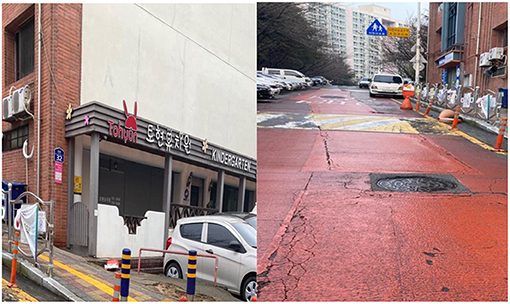
The EMF emission levels in kindergartens were measured based on the location of the UGTL in December 2020. This study includes 24 kindergartens across Busan, South Korea (12 kindergartens located near UGTL and 12 kindergartens without UGTL). The UGTL locations and kindergartens in Busan City were accessed from Busan Korea Electric Corporation and Ministry of Education, Korea, respectively. Then, 24 kindergartens were sampled randomly from the list of kindergartens based on the UGTL location. We calculated the EMF emission levels with two measurement techniques as shown in Figure 1: (i) EMF measurement around the kindergartens and (ii) EMF measurement from the point of the UGTL to kindergartens. The emission levels of EMF were measured using EMDEX II (Electric and Magnetic Digital Exposure Meter). At 0.5, 1, and 1.5 m from ground level, we monitored the EMF emission levels. The data were analyzed using the Statistical Package for Social Science (SPSS) version 23. To identify the association of EMF emission and UGTL, a simple linear regression analysis was performed.


FIGURE 1
www.frontiersin.org

Figure 1. Spot measurement around kindergarten and from the underground transmission line (UGTL) to kindergarten.

Results and Discussion

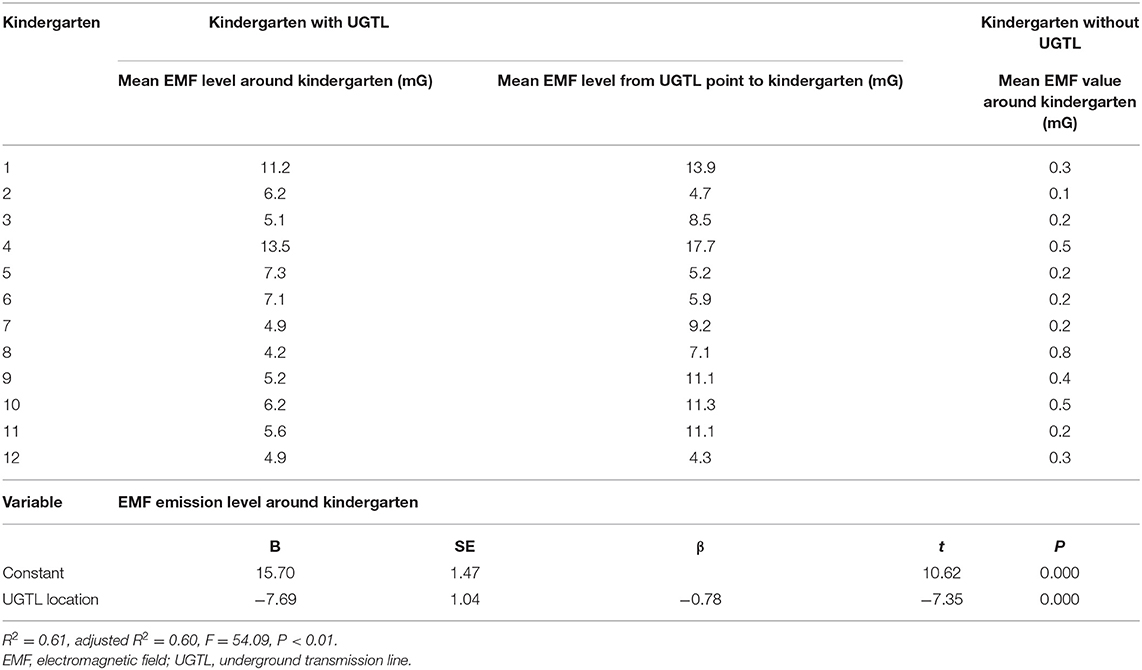
Table 1 shows the variation in EMF emission levels in the selected kindergartens. The maximum mean value of 13.5 mG was monitored around kindergarten, and 17.7 mG was measured from the UGTL to kindergarten, which is a relatively high emission level. Based on the UGTL, EMF level was found to be very low (below 1 mG) in kindergartens that were not located around transmission lines as compared with kindergartens with transmission lines nearby. EMF emission level around the kindergartens was found to be statistically significant with UGTL location (P < 0.01).

 
TABLE 1
www.frontiersin.org

Table 1. EMF emission level in selected kindergartens.

EMF emission levels in kindergartens located along the transmission line were found to be lower than those of the international (<2,000 mG) and Korean (<833 mG) guidelines (5, 8). According to the WHO research findings, studies had shown that long-term exposure to EMF may be a possible risk factor for childhood leukemia (9). To find out whether there is a causal correlation, numerous studies have comprehensively studied power lines and cancers. Previous studies showed that power-line-generated EMFs have frequencies that are too low to impact living cells or damage DNA. There is insufficient evidence available to establish a justification for setting exposure limits in regard to the possible long-term consequences of exposure (e.g., leukemia) (3, 9). The International Commission on Non-Ionizing Radiation Protection (ICNIRP) recommendations for reducing EMF effects on humans including children have been adopted worldwide (10). They primarily guard against the short-term health effects of exposure to EMFs. EMFs from power lines, through electric fields induced in the body, may cause significant changes in the biological system (511). Kindergartens are considered to be highly exposed, and long-term EMF exposure possibly leads to health risks especially on children from kindergartens (7, 1214). Different methods have been recommended by some countries to restrict EMF exposure in younger children. In South Korea, they also embraced the ICNIRP recommendations to limit the sensitivity of EMF exposure, but still, public citizens and parents are not highly concerned about the negative impacts of EMF exposure on children. To restrict public exposure to power-frequency EMF, scientific criteria have been established such that induced currents are below those that occur naturally in the body (3, 5). While the guidelines and reports cover different causes, they do not explicitly cover possible health risks associated with EMF exposure on a long-term basis. In our investigation, EMF emission levels on selected kindergartens were found to be significantly higher compared with those in other kindergartens not located near UGTL, supported by the study conducted in kindergartens to assess the RF-EMF emission levels (1). In certain situations, if the EMF level is high around the kindergartens, there might be some other electrical sources that may affect the EMF value if there is no UGTL nearby. Our preliminary findings have implications for the design of larger studies and the improvement of EMF-related policies in South Korea and other nations. Besides, EMF exposure effects on children are not well-established, children’s susceptibility to EMF exposure should be lowered, and safety precaution standards should be enforced. Furthermore, potential hazards from EMF exposure should be studied more accurately to develop appropriate public policy for the protection of the children’s health.

Conclusion

This article provides the ideal concept for conducting the personal EMF exposure assessment from UGTL among the children for future EMF-related epidemiological studies. It is not appropriate to ignore the fact that EMFs are potentially carcinogenic to children. Proper installation solutions should be implemented for the minimization of the EMF level around the public sensitive areas with routine monitoring.

References

1. Bhatt CR, Redmayne M, Billah B, Abramson MJ, Benke G. Radiofrequency-electromagnetic field exposures in kindergarten children. J Expo Sci Environ Epidemiol. (2017) 27:497–504. doi: 10.1038/jes.2016.55

PubMed Abstract | CrossRef Full Text | Google Scholar

2. Bolte JF, Eikelboom T. Personal radiofrequency electromagnetic field measurements in the Netherlands: exposure level and variability for everyday activities, times of day and types of area. Environ Int. (2012) 48:133–42. doi: 10.1016/j.envint.2012.07.006

PubMed Abstract | CrossRef Full Text | Google Scholar

3. Gajsek P, Ravazzani P, Wiart J, Grellier J, Samaras T, Thuroczy G. Electromagnetic field exposure assessment in Europe radiofrequency fields (10 MHz-6 GHz). J Expo Sci Environ Epidemiol. (2015) 25:37–44. doi: 10.1038/jes.2013.40

PubMed Abstract | CrossRef Full Text | Google Scholar

4. Urbinello D, Huss A, Beekhuizen J, Vermeulen R, Röösli M. Use of portable exposure meters for comparing mobile phone base station radiation in different types of areas in the cities of Basel and Amsterdam. Sci Total Environ. (2014) 468–9:1028–33. doi: 10.1016/j.scitotenv.2013.09.012

PubMed Abstract | CrossRef Full Text | Google Scholar

5. Moon JH. Health effects of electromagnetic fields on children. Clin Exp Pediatr. (2020) 63:422–8. doi: 10.3345/cep.2019.01494

PubMed Abstract | CrossRef Full Text | Google Scholar

6. Draper G, Vincent T, Kroll ME, Swanson J. Childhood cancer in relation to distance from high voltage power lines in England and Wales: a case-control study. BMJ. (2005) 330:1290. doi: 10.1136/bmj.330.7503.1290

PubMed Abstract | CrossRef Full Text | Google Scholar

7. Kheifets L, Repacholi M, Saunders R, van Deventer. E. The sensitivity of children to electromagnetic fields. Pediatrics. (2005) 116:e303–13. doi: 10.1542/peds.2004-2541

CrossRef Full Text | Google Scholar

8. National Institute of Environmental Research. Environmental Health. (2019). Available online at: https://www.nier.go.kr/NIER/eng/rf/nren-rf-0101.do?menuNo=71001

Google Scholar

9. World Health Organization (WHO). Electromagnetic Fields and Public Health; Exposure to Extremely Low Frequency Fields. (2007). Available online at: https://www.who.int/peh-emf/publications/facts/fs322/en

Google Scholar

10. IARC Working Group on the Evaluation of Carcinogenic Risks to Humans. Non-ionizing radiation, part 2: radiofrequency electromagnetic fields. IARC Monogr Eval Carcinog Risks Hum. (2013) 102(Pt 2):1–460.

Google Scholar

11. IARC Working Group on the Evaluation of Carcinogenic Risks to Humans. Non-ionizing radiation, part 1: static and extremely low-frequency (ELF) electric and magnetic fields. IARC Monogr Eval Carcinog Risks Hum. (2002) 80:1–395.

Google Scholar

12. Acharya SR, Moon DH, Shin YC. Assessment of VOCs, PM10, and formaldehyde exposure in the hair salons of South Korea. J Environ Health Sustain Dev. (2020) 5:1103–8. doi: 10.18502/jehsd.v5i4.4958

CrossRef Full Text | Google Scholar

13. Bhatt CR, Abramson MJ, Benke G. Wi-Fi radiation exposures to children in kindergartens and schools – results should lessen parental concerns. Aust N Z J Public Health. (2017) 41:647–8. doi: 10.1111/1753-6405.12706

PubMed Abstract | CrossRef Full Text | Google Scholar

14. Joseph W, Frei P, Roosli M, Thuroczy G, Gajsek P, Trcek T, et al. Comparison of personal radio frequency electromagnetic field exposure in different urban areas across Europe. Environ Res. (2010) 110:658–63. doi: 10.1016/j.envres.2010.06.009

PubMed Abstract | CrossRef Full Text | Google Scholar


Keywords: electromagnetic field, transmission line, exposure, children, risk

Citation: Acharya SR, Shin YC, Moon DH and Pahari S (2021) Electromagnetic Field Exposure in Kindergarten Children: Responsive Health Risk Concern. Front. Pediatr. 9:694407. doi: 10.3389/fped.2021.694407

Received: 13 April 2021; Accepted: 28 May 2021;
Published: 05 July 2021.

Edited by:

Linda Min, Ulsan College, South Korea

Reviewed by:

Surya Nepal, Changwon National University, South Korea
Birat Kandel, Tribhuvan University, Nepal (Prakshit Niraula contributed to the review of Birat Kandel)

Copyright © 2021 Acharya, Shin, Moon and Pahari. This is an open-access article distributed under the terms of the Creative Commons Attribution License (CC BY). The use, distribution or reproduction in other forums is permitted, provided the original author(s) and the copyright owner(s) are credited and that the original publication in this journal is cited, in accordance with accepted academic practice. No use, distribution or reproduction is permitted which does not comply with these terms.


Posted in Uncategorized | Comments Off on Study – Electromagnetic Field Exposure in Kindergarten Children: Responsive Health Risk Concern